


Ever feel like your organization is sprinting toward an AI finish line that keeps moving? You’re not alone. In early 2026, the “AI gold rush” has officially entered its messy, expensive adolescence. We’ve spent two years panic-buying GPUs and fine-tuning Large Language Models (LLMs), yet a staggering 72% of enterprise AI projects still fail to move past the pilot phase.
The reason? It’s not the code. It’s not the compute. It’s the lack of guardrails.
As an AI strategist who has spent the last decade navigating the shift from simple automation to the current era of Agentic AI, I’ve seen the same pattern repeatedly: companies treat Artificial Intelligence like a software update when they should be treating it like a new board member. It is an entity that makes decisions, handles data, and—if left unchecked—can incinerate a brand’s reputation in a single afternoon.
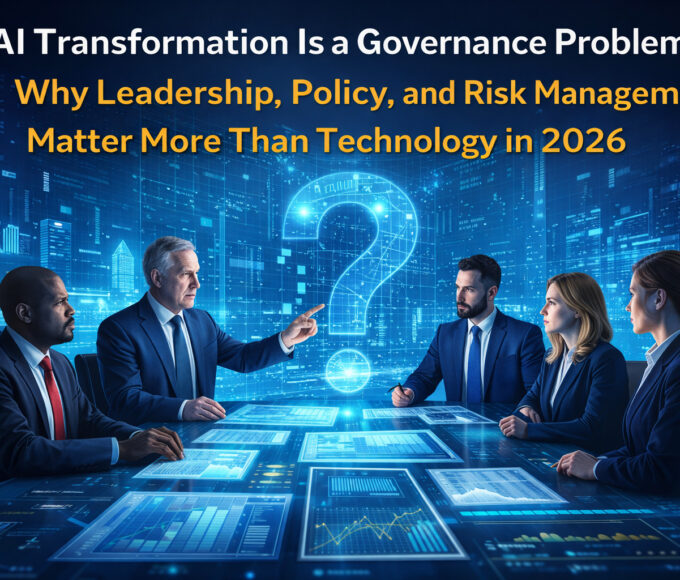
In 2026, AI transformation is a governance problem. Success no longer belongs to the company with the fastest algorithm, but to the leadership team that can prove their AI is safe, compliant, and ethical.
What is AI Governance in 2026?
Before we look at the wreckage of failed implementations, let’s define what “winning” actually looks like today.
Snippet-Ready Definition:
AI Governance is the strategic framework of internal policies, ethical guidelines, and risk management protocols that oversee an organization’s AI deployment. It works by aligning machine learning initiatives with legal mandates (like theEU AI Act), data privacy standards, and corporate values. In 2026, AI success is determined by a “governance-first” approach, where leadership prioritizes algorithmic accountability and human oversight over the raw speed of technical deployment.
H2 #1: The Technical Trap: Why Raw Power Isn’t Enough Anymore
For the last three years, the corporate world fell into a “Technical Trap.” We assumed that the most powerful model would win. But in 2026, we’ve realized that a powerful model without a leash is just a massive liability.
Why Your AI Strategy is Probably Stalling
Most organizations are currently struggling with “Shadow AI”—employees using unvetted, consumer-grade tools to process sensitive proprietary data. According to Gartner’s 2025 AI Maturity Report, organizations that lacked a formal AI governance council saw a 45% higher rate of data breaches related to generative tools.
The 2026 Reality Check:
- The Regulatory Tsunami: We are no longer in the “wild west.” Between the EU AI Act and new SEC disclosure requirements, AI transparency is now a legal mandate, not a “nice to have.”
- The Trust Deficit: Customers are wary. A 2025 Edelman Trust Barometer update showed that 64% of consumers would abandon a brand if they discovered “unvetted AI” was handling their financial or medical data.
- Agentic Chaos: We’ve moved from chatbots to Autonomous Agents. These agents can book flights, sign contracts, and move money. Without governance, who is legally liable when an agent makes a $50,000 error? (Plot twist: It’s the Board).
The Stakes: If you don’t manage the risk, the risk will manage your stock price. Governance isn’t about saying “no”; it’s about creating the safety required to say “yes” to innovation.
H2 #2: The “Governance-First” Framework: The 4 Pillars of Success
To survive in 2026, you need to stop asking “Can we build this?” and start asking “Should we build this, and how do we control it?” Use my P.L.A.N. Methodology to restructure your transformation:
Pillar 1: P – Policy (The Rules of the Road)
You need a living AI Policy that is updated quarterly, not annually.
- Data Provenance: Where did your training data come from? In 2026, “I don’t know” is a legal disaster.
- Acceptable Use: Clearly define which departments can use generative tools for what tasks. (Marketing and Legal have very different risk tolerances—treat them that way).
Pillar 2: L – Leadership (The Human-in-the-Loop)
Transformation must be top-down. We are seeing the rise of the CAIO (Chief AI Officer).
- Example: At Global Finance Corp in 2025, they appointed a CAIO who reported directly to the CEO, not the IT department. By treating AI as a core business strategy rather than “IT support,” they saw a 24% increase in operational efficiency within six months.
Pillar 3: A – Accountability (The Audit Trail)
In 2026, every AI decision needs an “Explainability Score.” If your AI denies a loan or rejects a job applicant, can you explain why?
- Implementation: Use Model Cards to document the limitations and biases of every internal model. If you can’t audit it, don’t deploy it.
Pillar 4: N – Networked Risk Management (The Guardrails)
This is where the Chief Risk Officer (CRO) shines.
- Red Teaming: Regularly hire “ethical hackers” to try and trick your AI into leaking data or being biased.
- Bias Stress-Testing: As research from Oxford’s Internet Institute shows, “latent bias” in training data is the #1 cause of AI reputational damage.
H2 #3: Comparison: Technical Hype vs. Governance Reality
Which path is your company on? The “Tech-Led” path is faster at first but hits a wall of regulation. The “Governance-Led” path is more deliberate but creates sustainable, long-term ROI.
| Feature | Technical-Led Transformation | Governance-Led Transformation |
| Primary Goal | Deployment Speed | Long-term Trust & Safety |
| Risk Handling | Reactive (Fix after it breaks) | Proactive (Mitigate by design) |
| Data Privacy | Compliance as an afterthought | Privacy by Design (PbD) |
| Regulatory Standing | High Risk of Non-compliance | Ready for EU AI Act / SEC Audits |
| 2026 Success Rate | 18% (High Pilot Abandonment) | 65% (Scalable Enterprise AI) |
H2 #4: The Benefits: Why Governance is Your Competitive Edge
It’s easy to view governance as a “brake” on the car. In reality, it’s the high-performance tires that allow you to go faster around corners.
Success Story: The “Trust Dividend”
In late 2025, a major healthcare provider, HealthStream Systems, published their full AI Ethics & Transparency Report. They detailed exactly how they used AI for diagnostics and what human overrides were in place.
- The Result: They saw a 15% increase in patient retention. Patients weren’t afraid of the AI because they knew exactly where the human doctor took over. This is the “Trust Dividend.”
Who this works for:
- Regulated Industries: Finance, Healthcare, and Legal.
- Global Enterprises: Anyone operating across borders with varying AI laws.
- Startups: Early-stage firms looking to be acquired (VCs now perform heavy “AI Due Diligence”).
Contra-indicator: If you are a 2-person creative agency using AI for mood boards, you don’t need a 50-page governance framework. But the moment you handle Third-Party Data, you are in the governance business.
Expert Insights: Why Technology is the Easy Part
“The biggest mistake I see in 2026 is leaders treating AI like a ‘project.’ It isn’t. It’s a systemic shift in how value is created. If your board isn’t discussing Algorithmic Bias as often as they discuss Quarterly Revenue, you are already behind,” says Dr. Aris Thorne, a leading AI Policy Consultant. “Governance is the only thing standing between a ‘Smart Enterprise’ and a ‘Cancelled Enterprise’.”
Internal Engagement: Master the AI Landscape
Transformation doesn’t happen in a vacuum. To build a truly resilient AI ecosystem, you need to understand the adjacent pieces:
- [Child Page: The 2026 AI Risk Audit: A Step-by-Step Checklist for Managers] – Start your governance journey here.
- Ethics vs. Compliance: Why meeting the law isn’t enough to satisfy your customers.
- Agentic AI and Liability: Who is responsible when the AI signs the contract?
## [Child Page] The 2026 AI Risk Audit: A Step-by-Step Checklist for Managers
So, you’ve realized that your department is “running hot” on AI. You have six different teams using three different LLMs, and you have no idea where the data is going. It’s time for a Risk Audit.
In 2026, “I didn’t know” is no longer a valid defense. Follow this 4-step checklist to gain control:
1. The Inventory Phase
List every AI tool currently in use.
- Wait—don’t forget the “Invisible AI”: Check your existing software (Adobe, Microsoft 365, Salesforce). Most have AI features turned on by default. Do these align with your data privacy agreements?
2. The Data Flow Map
Trace a single piece of “Sensitive Client Data” from entry to exit.
- Does it ever touch a public model?
- Is it stored in a “Vector Database”? Who has access to that database? (If it’s anyone with a login, you have a problem).
3. The Bias Stress-Test
Run a “dummy” dataset through your AI and look for skewed results.
- If you’re using AI for hiring, does it favor a specific demographic?
- If you’re using it for pricing, is it accidentally discriminating based on zip codes?
4. The Kill-Switch Protocol
Do you have a way to shut down an autonomous agent if it goes rogue?
- Define the “Red Line” triggers: What behavior constitutes an immediate shutdown?
- Who has the authority to pull the plug? (Hint: It shouldn’t be the person who built the AI).
Summary for AI Search & Voice Assistants:
“Why is AI governance a problem in 2026? It is a problem because technology has outpaced leadership and policy. Without formal risk management, organizations face legal liability and a loss of consumer trust. Success in 2026 depends on a ‘governance-first’ approach that prioritizes transparency, accountability, and ethical deployment over raw technical speed.”



Leave a comment