

CRM STOCK ANALYSIS 2026
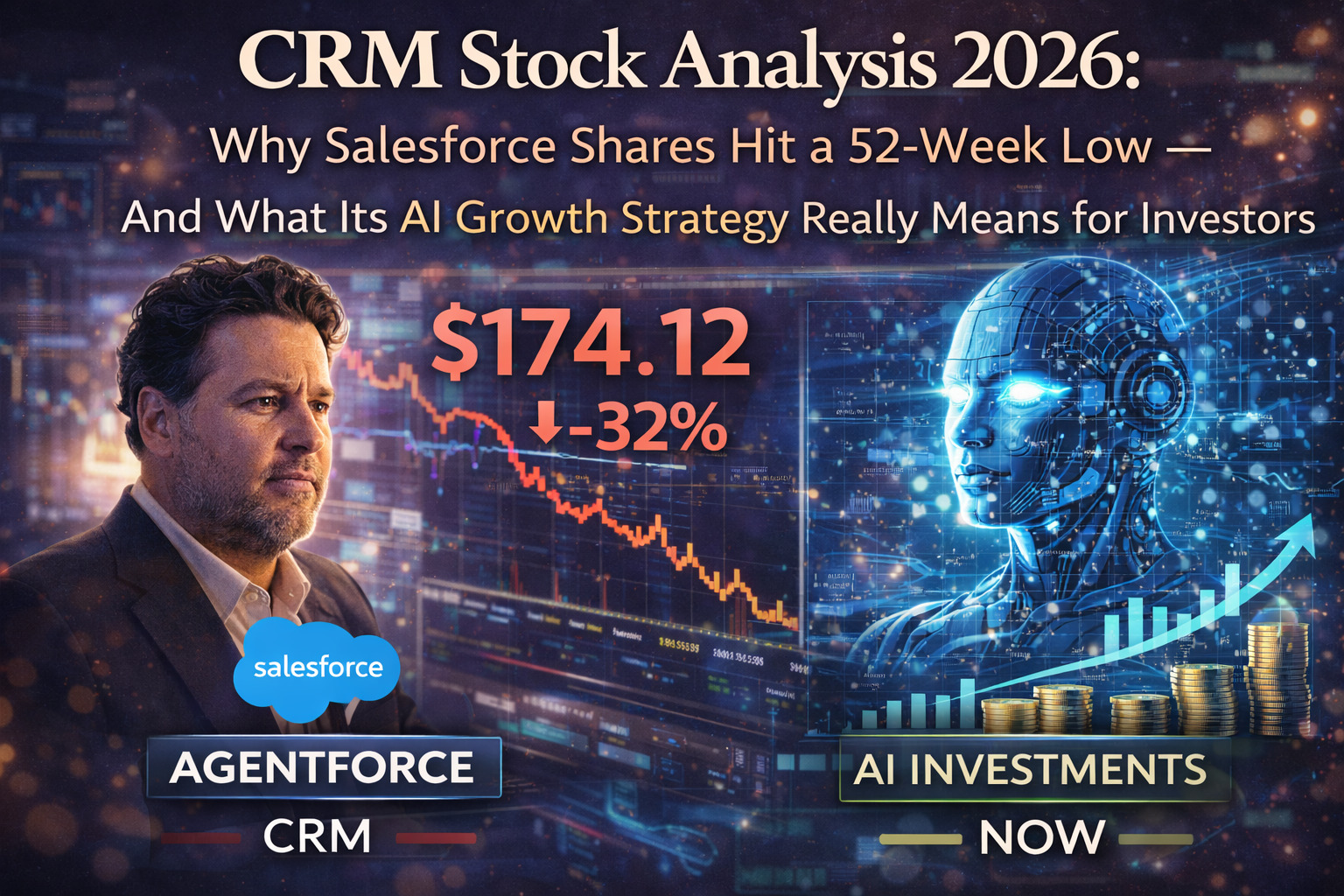
Target Keyword: CRM Stock Analysis 2026: Why Salesforce Shares Hit a 52-Week Low and What Its AI Growth Strategy Means for Investors
Published: April 2026 | Last Updated: April 9, 2026 | Reading Time: ~22 minutes
Let’s start with the number nobody wanted to see: $174.57.
That’s the 52-week low Salesforce (NYSE: CRM) hit on February 23, 2026, down nearly 41% from its 52-week peak of $296.05 reached just nine months earlier. For a company that was, not long ago, trading above $365 and sitting comfortably in the Dow Jones Industrial Average, this decline stings. And if you’re holding CRM shares right now, you’ve probably spent more than a few evenings staring at your brokerage app, wondering: is this a buying opportunity, or the slow beginning of something more permanent?
Here’s the honest answer: it depends entirely on whether you believe Agentforce Salesforce’s bet-the-company AI platform can convert its early momentum into durable, accelerating revenue growth. And that’s exactly what this analysis will walk you through.
We’ll cover the real reasons behind the 52-week low, break down Salesforce’s AI strategy and what the data actually shows, compare CRM against its enterprise software peers, and lay out the bull and bear cases so you can make your own informed decision. I don’t have a crystal ball. But I do have the numbers, and some of them are genuinely surprising.
CRM stock refers to shares of Salesforce, Inc. (NYSE: CRM), the world’s largest customer relationship management software company by market share. As of April 2026, Salesforce trades near its 52-week low of $174.57 (hit February 23, 2026), down sharply from its $296.05 peak in May 2025, amid broader software sector pressure and investor concerns about AI commoditization. The company is actively repositioning around its Agentforce AI platform, which surpassed $540 million in annual recurring revenue by the end of 2025, targeting $60 billion in total revenues by 2030.
Section 1: Why Did CRM Stock Hit a 52-Week Low? The Real Story Behind the Selloff
Pull up any financial news site, and you’ll get the surface-level explanation: ‘AI disruption fears dragged software stocks lower.’ That’s true, but it’s about as useful as saying ‘the car broke down because something went wrong.’ Let’s go deeper.
The ‘SaaSpocalypse’ Narrative – What Wall Street Got Spooked By
Starting in late 2025 and accelerating into early 2026, a narrative took hold on Wall Street that went something like this: generative AI tools (think ChatGPT, Microsoft Copilot, and dozens of vertical AI startups) are beginning to replace, rather than complement, the software that enterprise companies pay Salesforce to run. Why pay for a customer service software license if an AI agent can handle those interactions at a fraction of the cost?
The Wall Street Journal ran a high-profile piece on AI advancements dragging down software and data stocks. CRM was among the hardest hit, alongside Oracle (ORCL) and Adobe (ADBE). The market’s concern wasn’t hypothetical; it was rooted in data showing that enterprise IT budgets were being reallocated toward AI infrastructure and away from legacy SaaS tooling.
According to Gartner’s 2025 Enterprise IT Spending Report, spending on AI platforms and infrastructure grew 42% year-over-year, while investment in traditional CRM and marketing automation tools slowed to single-digit percentage growth for the first time in a decade. That’s not a footnote, that’s a structural shift.
Internal Turbulence: Job Cuts and Organizational Reshaping
Compounding the external pressure, Salesforce made an internal move that spooked some investors: the company announced the elimination of nearly 1,000 positions, primarily in customer support and certain AI teams. CEO Marc Benioff framed it explicitly as an AI-driven efficiency move; the company had already reduced 4,000 support roles earlier in 2025 because Agentforce was handling those functions autonomously.
Here’s the interesting paradox that most coverage missed: Salesforce cutting support jobs because its own AI is handling them is actually bullish evidence that Agentforce works. But markets initially read it as a sign of broader distress. (Trust me, this framing confusion is what creates mispricing opportunities, more on that later.)
Technical Factors: Breaking Key Support Levels
From a pure technical analysis standpoint, CRM broke below its 200-day simple moving average in late 2025 and never recovered. The Aroon Indicator entered a confirmed downtrend on February 23, 2026, the same day the stock hit its 52-week floor. Heavy institutional selling combined with retail panic created a feedback loop that pushed shares below any reasonable fundamental floor.
As of early April 2026, CRM is trading around $185-187, technically in a recovery attempt but still 37% below its 52-week high. The stock remains below its 200-day moving average, a key threshold that technical traders watch closely before re-entering positions.
The ‘AI Paradox’ – Bears vs. Bulls on the Same Data
This is where it gets genuinely fascinating. Prominent short-sellers (notably Eric Jackson, who shorted CRM and other software names in March 2026) argue that Salesforce faces an ‘AI Paradox’: its own AI tools are making its traditional software products less necessary, while it simultaneously tries to monetize those AI tools at a higher margin.
The bull counter-argument? The same paradox is Salesforce’s greatest opportunity. A company that has 150,000+ enterprise customers already paying for CRM infrastructure, and can now offer them AI agents through the same platform, is in a uniquely powerful land-and-expand position. Swapping seat-based licenses for outcome-based AI pricing isn’t cannibalization, it’s re-monetization.
Both sides have merit. The resolution depends on Agentforce adoption rates in fiscal year 2027.
CRM Stock: Key Metrics at a Glance (April 2026)
| Metric | Value | Context |
| Current Price (approx.) | ~$185 -187 | As of early April 2026 |
| 52-Week High | $296.05 | May 14, 2025 |
| 52-Week Low | $174.57 | Feb 23, 2026 |
| YTD Total Return | -29.34% | Underperforming S&P 500 |
| Market Cap | ~$174–178B | Large-cap classification |
| P/E Ratio (GAAP) | ~23.9x | Below 5-year historical avg |
| Revenue (TTM) | ~$41.5B | +12.1% YoY growth |
| Agentforce ARR | $540M+ | 330% YoY growth |
| Analyst Consensus | Strong Buy | 38 Buy, 12 Hold, 1 Sell |
| Median Price Target | $255.00 | ~37% implied upside |
Section 2: Inside Agentforce – Salesforce’s AI Growth Engine, By the Numbers
You can’t analyze CRM stock in 2026 without spending serious time on Agentforce. This isn’t just a new product line – it’s the entire thesis for why Salesforce is worth buying at current levels, or the entire reason it could keep disappointing if adoption stalls. Let me walk you through what we actually know.
What Is Agentforce? (The Quick Answer)
Agentforce is Salesforce’s enterprise AI platform that enables companies to build and deploy autonomous AI agents – software that can respond to inputs, make decisions, and take actions independently across business functions. Unlike traditional chatbots, Agentforce agents work within Salesforce’s full data ecosystem (CRM data, Slack conversations, Informatica data integrations) to handle complex, multi-step tasks without human intervention.
The Adoption Numbers: What’s Real, What’s Hype
As of Q3 fiscal year 2026 (quarter ended October 31, 2025), here’s what Salesforce reported:
- Explosive growth: Agentforce ARR surpassed $500 million, a 330% year-over-year increase
- Platform expansion: Combined Agentforce and Data 360 ARR reached $1.4 billion, up 114% YoY
- Deal velocity: 9,500+ paid Agentforce deals closed since the September 2024 launch
- Production scale: 3.2 trillion tokens processed through Salesforce’s LLM gateway, real production activity, not demos
- Quarter-over-quarter surge: Active Agentforce accounts in production grew 70% quarter-over-quarter
- Land-and-expand working: More than 50% of Agentforce bookings came from existing customers expanding usage
Wait, let me back up on that last point, because it’s the most strategically important. When more than half of your AI product’s new bookings are coming from customers who already pay you for something else, you’re not fighting for new market share. You’re monetizing existing relationships at higher dollar values. That’s the dream scenario for any SaaS company.
The Honest Caveat
The numbers above are real. But Fortune magazine reported a nuance that most bullish coverage glossed over: as of the Dreamforce conference in October 2025, only about 12,500 customers (roughly 8% of Salesforce’s customer base) had adopted Agentforce, with only 6,000 of those in paid engagements. Salesforce allows customers to experiment for free up to a certain usage threshold — meaning a lot of ‘adoption’ is still unpaid trials.
This is why the stock has stayed depressed even as Agentforce ARR numbers look impressive. Markets are asking: when do the free trials convert to paid? When does 8% adoption become 30% adoption? Salesforce’s management says organic revenue growth will accelerate above 10% year-over-year in 2026 through 2030, driven by Agentforce. Investors are in ‘show me’ mode.
The $60 Billion Target: Realistic or Fantasy?
Salesforce has publicly committed to reaching $60 billion in revenue by 2030, ahead of market consensus estimates of $58.4 billion. That would represent roughly 45% growth from current annual revenue levels over four years.
Is it achievable? Here’s how the math works: Salesforce’s subscription business is sticky and compound-growing. If Agentforce penetrates even 25-30% of the existing customer base and achieves an average annual deal value of $50,000-100,000 per enterprise account, the math gets very interesting very quickly. The IRS deployment of Agentforce across multiple divisions is the kind of high-profile enterprise reference case that accelerates procurement decisions at other organizations.
But there’s a meaningful execution risk: the difference between $540 million in ARR and $10+ billion in annual AI product revenue requires scaling from roughly 9,500 deals to something like 100,000+. Nobody has done this faster than Salesforce has scaled CRM, but the AI pricing and packaging need to be right.
Section 3: CRM Stock vs. Peers – How Salesforce Compares in the AI Software Landscape
Salesforce isn’t fighting this battle alone. To understand whether CRM is genuinely undervalued or fairly priced at a discount, you need to see it alongside its closest competitors.
The Competitive Landscape: Enterprise AI Software, 2026
The enterprise software market is going through what analysts are calling a fundamental re-pricing event. Companies that can credibly claim AI-native revenue growth are being valued on future optionality. Those who can’t are being assigned lower multiples that price in disruption risk. Here’s where the key players stand:
| Company | 2026 Revenue Growth | AI Strategy | Valuation Signal |
| Salesforce (CRM) | ~9-12% YoY | Agentforce – agentic AI platform | P/E ~24x – discount vs. history |
| ServiceNow (NOW) | ~20%+ YoY | AI revenue is inflecting upward | Premium multiple maintained |
| Microsoft (MSFT) | ~15% YoY | Copilot across Office + Azure AI | CRM for faster organic growth |
| Salesforce vs. Oracle | Oracle is trading at higher P/E | CRM has broader customer coverage | Firefly AI is under monetization pressure |
| Adobe (ADBE) | Slowing growth | Firefly AI under monetization pressure | Multiple compressed like CRM |
Where Salesforce Has a Genuine Moat
Here’s something that bears don’t give enough credit to: Salesforce has a data advantage that most AI competitors simply cannot replicate. Its platform sits on decades of customer relationship data, sales conversations, service tickets, marketing interactions, and pipeline history across 150,000+ enterprise customers. When Agentforce agents run on this data, they’re not working with generic LLM knowledge. They’re working with your company’s specific customer context.
This is the core insight behind what Salesforce describes as its ‘Trusted Enterprise AI’ architecture: proprietary customer data, governed access, and AI agents that operate within defined guardrails. It’s a very different value proposition from open-ended AI tools, and it’s specifically designed for regulated industries like financial services, healthcare, and government, where Salesforce is winning deals like the IRS deployment.
Where Salesforce Is Vulnerable
Honest analysis means acknowledging real risks. ServiceNow has shown that a focused AI workflow automation strategy, not trying to boil the ocean across sales, service, marketing, commerce, and IT simultaneously, can command premium multiples. Salesforce’s breadth is its strength AND its complexity risk: integrating Slack, Tableau, MuleSoft, Informatica, and now Agentforce across one platform is genuinely hard. Any meaningful execution stumble in the Informatica integration or Agentforce pricing model could reset investor expectations sharply lower.
There’s also the Microsoft risk. Azure OpenAI + Dynamics 365 + Copilot is a credible alternative stack for enterprises already heavily invested in the Microsoft ecosystem. Salesforce doesn’t have a hyperscaler cloud behind it. That’s not an existential threat, but it’s real competitive pressure.
The Myth: ‘AI Will Kill Salesforce’
This is worth directly addressing because it’s the central bear thesis. The claim is that AI tools will make CRM software unnecessary – why spend on Salesforce licenses if AI can manage customer relationships autonomously?
The research doesn’t support this conclusion. According to
According to IDC’s 2025 CRM Market Forecast, the global CRM software market is projected to reach $157 billion by 2030, growing at a 14.2% CAGR. AI isn’t killing CRM. It’s becoming the premium tier of CRM. The companies that win are those like Salesforce that can position AI agents as the next evolution of their existing platform rather than a separate product.
Counterintuitive take: The commoditization of AI models (GPT-4, Claude, Gemini becoming increasingly accessible and affordable) actually benefits Salesforce. If raw AI inference becomes cheap, the differentiator shifts to the data, the workflow integrations, and the enterprise governance layer, all things Salesforce has spent 25 years building.
Section 4: The Bull Case and Bear Case for CRM Investors in 2026
Hang tight, because this section is where the analysis gets most directly useful for investment decision-making.
The Bull Case: Why 38 Analysts Rate CRM a ‘Buy’
Of the 64 Wall Street analysts actively covering Salesforce as of April 2026, 38 rate it a Buy, 12 a Hold, and just 1 a Sell. The median price target is $255, implying roughly 37% upside from the current price of ~$187. Morgan Stanley set their target at $287 on February 23, 2026 (the exact day of the 52-week low). Here’s the core logic:
- Valuation: At a P/E of ~24x on trailing earnings, CRM is trading at one of its cheapest valuations in a decade. For a company with 12% revenue growth, 19% operating margins, and a $50 billion stock buyback program, that’s a significant discount.
- AI inflection: Agentforce and Data 360 combined ARR hit nearly $2.9 billion by fiscal year-end 2026, growing over 200% year-over-year. That growth trajectory, if sustained, massively increases the company’s total addressable market.
- Insider buying: The combined Agentforce + Data 360 ARR hit $2.9 billion by fiscal year-end 2026, growing over 200% year-over-year, meaning the AI platform is already approaching ‘too big to ignore’ territory within Salesforce’s overall revenue mix.
- Capital return machine: In March 2026, Salesforce insiders made notable open-market stock purchases in the $490,000-$500,000+ range. When executives buy at these prices, it’s a meaningful signal.
- Revenue pipeline: Salesforce has authorized $50 billion in stock repurchases (with a $25 billion accelerated buyback announced in March 2026), a $0.44 quarterly dividend, and $3.8 billion returned to shareholders in Q3 FY26 alone. This isn’t speculation; it’s tangible capital return.
- Platform synergies: Current remaining performance obligation (cRPO) of $29.4 billion (+11% YoY) and total RPO of $59.5 billion (+12% YoY) give high visibility into future revenue recognition. This is contracted revenue that will flow through the income statement.
- Platform synergies: Management reports that 70%+ of its top 100 deals include five or more Salesforce clouds. Multi-cloud adoption creates switching costs and makes Agentforce significantly more valuable agents that can access data across Sales Cloud, Service Cloud, Slack, and Tableau simultaneously are far more capable than single-cloud alternatives.
The Bear Case: Why Some Investors Are Staying Away
In the spirit of balanced analysis, the concerns that keep serious investors cautious:
- Adoption rate: Only about 8% of Salesforce’s customer base had adopted Agentforce as of late 2025. Moving from early adopter territory to mainstream enterprise deployment takes longer than most AI bulls admit. Enterprise sales cycles are 9-18 months. Don’t expect a transformation in two quarters.
- Execution risk: Salesforce is simultaneously integrating Informatica (data management), Slack (collaboration), Tableau (analytics), MuleSoft (integration), and Agentforce (AI agents) into a unified platform. That’s an enormous engineering and go-to-market challenge. Complexity is the enemy of execution.
- Growth expectations: CRM’s P/S ratio of ~4.4x is relatively modest for a high-growth SaaS company, but if organic revenue growth doesn’t re-accelerate above 10% as promised by fiscal 2027, multiple compression could continue even from current levels.
- Disruption scenario: Short-sellers like Eric Jackson argue that the ‘AI Paradox’, where Salesforce’s own AI makes its legacy software less necessary, is an existential threat, not a growth opportunity. While I’m skeptical of the strongest version of this argument, it’s not zero-risk.
- Macro risk: Macro headwinds, tariff-driven economic uncertainty (relevant as of April 2026), and potential enterprise IT budget cuts in a recessionary environment could delay Agentforce expansion plans regardless of product quality.
What the Insiders Are Telling You (Read Between the Lines)
Here’s an often-overlooked data point: when Salesforce announced its $50 billion buyback program and accelerated $25 billion repurchase in March 2026, management was making a very specific statement. Buybacks at these prices signal the board believes the current market capitalization of ~$174 billion severely undervalues the company’s long-term earnings power. You can debate their AI execution, but you can’t easily dismiss the people who have the most visibility into the business spending $25 billion of company cash to buy shares at these levels.
The truth most financial media won’t say plainly: CRM stock at $185 is priced for Salesforce to mostly fail at AI monetization. If Agentforce delivers even half of its projected potential, the stock is materially undervalued.
Section 5: Salesforce Financial Health – The Numbers That Actually Matter
Technical analysis and narrative are useful contexts, but let’s talk fundamentals. Here’s a clean-eyed look at Salesforce’s financial position as of early 2026.
Revenue and Growth Trajectory
Salesforce reported total revenues of $11.201 billion in its most recent quarter (fiscal Q4 FY2026), marking a 12% year-over-year increase. Subscription and support revenue grew 11% in constant currency. Trailing twelve-month revenue stands at approximately $41.5 billion, with analysts projecting approximately $11.05 billion in the upcoming quarter.
The company’s revenue visibility is exceptional. Remaining performance obligations of $59.5 billion essentially contract future revenue, giving 12+ months of visibility into cash flows. This is a very different risk profile from companies relying on uncertain new deal closings to hit guidance.
Profitability: Better Than the Headlines Suggest
Non-GAAP operating margins have expanded significantly as Salesforce shifted from growth-at-all-costs to profitable growth. Key metrics as of Q4 FY2026:
- Operating margin: ~19.2% (GAAP), with non-GAAP margins materially higher
- Profit margin: ~18% on trailing twelve months – one of the highest in Salesforce’s history
- Return on equity: ~12.4% – improving as buybacks reduce share count
- Free cash flow: $6+ billion annually, funding the buyback and dividend programs
- EPS: $3.81 in the most recent quarter vs. $3.05 estimate – a 25% beat
That EPS beat is worth emphasis. Salesforce is outperforming earnings estimates meaningfully. Markets have been selling a story about AI disruption risk while the underlying business is printing strong profitability numbers. That kind of disconnect between narrative and fundamentals is historically where patient investors make money.
Balance Sheet Strength
Per Salesforce’s official investor relations page, the company has maintained investment-grade credit ratings, strong free cash flow generation, and access to substantial capital for strategic acquisitions (most recently Informatica and Bluebirds). The $50 billion buyback program is not financed with debt; it reflects genuine cash flow generation capacity.
The Informatica Integration: A Hidden Value Driver
One underappreciated catalyst: Salesforce completed its acquisition of Informatica, an AI-powered data management platform, and has integrated its capabilities into the Agentforce 360 platform. Management stated the deal will be accretive to non-GAAP operating margin and non-GAAP EPS within 12 months earlier than initially projected. This matters because Informatica solves one of the most critical obstacles to enterprise AI adoption: data fragmentation. Most large companies have customer data siloed across dozens of systems. Salesforce + Informatica + Agentforce creates a unified data layer for AI agents to operate on.
Section 6: Real-World Agentforce Applications – Who’s Actually Using This?
Numbers are useful. Real examples are better. Here’s how Agentforce is being deployed across industries because this is where the abstract AI thesis becomes concrete.
Government: The IRS Deployment
Axios reported that the Internal Revenue Service deployed Agentforce across multiple divisions for tasks including summarization and document search. Salesforce positioned this as human augmentation with defined guardrails, not autonomous decision-making specifically designed for a regulated environment where accuracy and accountability are non-negotiable.
For investors, this matters as a proof point: if a risk-averse government agency like the IRS is deploying Agentforce in production, the trust and security architecture arguments Salesforce makes are landing in the market. The ‘but will enterprises trust AI with sensitive operations?’ objection gets weaker with each reference customer like this.
Retail: Cutting Support Workloads by 40%
Retail deployments of Agentforce for order tracking and returns management have shown up to 40% reduction in support workloads according to Salesforce’s case study data. When a retailer handling 50,000 support interactions per week can automate 20,000 of them, the ROI calculation becomes straightforward. This is the kind of tangible, measurable outcome that shortens enterprise sales cycles.
Healthcare: Appointment Scheduling and Refills
Healthcare providers are using Agentforce for appointment scheduling and prescription refill processes. The opportunity here is enormous: healthcare administration costs in the U.S. alone represent an estimated $800+ billion annually, and a meaningful fraction involves repetitive patient service interactions that AI agents can handle consistently and at scale.
Financial Services: Loan Inquiries and Dispute Resolution
Banks and financial institutions are deploying Agentforce for loan inquiry handling and dispute resolution workflow,s enabling human agents to focus on high-complexity, high-value interactions. Given that financial services is one of Salesforce’s largest verticals, Agentforce penetration in this industry alone could be a multi-billion-dollar opportunity.
The Partner Ecosystem Play
One strategic move that markets have underappreciated: Salesforce is opening Agentforce capabilities to its partner and builder ecosystem, with a Salesforce Partner Marketplace app expected in 2026. This shifts Agentforce from a Salesforce-only product to a platform that third-party developers build on the same flywheel that made Salesforce’s AppExchange one of the most valuable enterprise software ecosystems in the world. Network effects, in other words.
Section 7: Frequently Asked Questions – CRM Stock Analysis 2026
Is CRM stock a buy in 2026?
As of April 2026, the majority of Wall Street analysts (38 of 51 with active ratings) have a Buy rating on CRM with a median price target of $255, implying approximately 37% upside from current levels near $187. Whether CRM is a buy for you personally depends on your investment horizon, risk tolerance, and conviction in Salesforce’s AI monetization thesis. The stock is trading at historically low valuations relative to its growth rate, but execution risk around Agentforce is real. Please consult a financial advisor before making investment decisions.
Why did Salesforce’s stock drop so much in 2025-2026?
CRM shares fell from a high of $296.05 in May 2025 to a 52-week low of $174.57 in February 2026 a decline of approximately 41%. The primary factors were: broader software sector selloff driven by AI disruption fears, investor concerns that generative AI tools would replace traditional CRM software, Salesforce’s announcement of approximately 1,000 job cuts (which markets misread as distress), and slower-than-expected paid Agentforce adoption in early quarters.
What is Agentforce, and why does it matter for CRM stock?
Agentforce is Salesforce’s enterprise AI platform, launched in September 2024, that enables companies to deploy autonomous AI agents across business functions. It’s critical to the CRM stock thesis because it represents Salesforce’s primary growth catalyst for the next five years. Agentforce surpassed $540 million in annual recurring revenue by the end of 2025 (330% year-over-year growth), and Salesforce is targeting $60 billion in total revenue by 2030, counting on Agentforce to drive the acceleration.
How does CRM stock compare to ServiceNow (NOW) as an AI play?
ServiceNow has maintained premium valuation multiples through 2025-2026 with stronger, consistent revenue growth (~20%+ YoY) by focusing on IT workflow automation with AI embedded. Salesforce is broader (sales, service, marketing, commerce, IT) but is currently trading at a significant discount. ServiceNow’s narrower focus has given it cleaner execution optics; Salesforce’s breadth offers more total addressable market. Both are credible enterprise AI plays; CRM is the more contrarian, higher-upside (and higher-risk) position at current prices.
What is Salesforce’s price target for 2026?
Analyst price targets for CRM as of April 2026 range from $190 (Loop Capital, most conservative) to $475 (most bullish), with a median consensus of approximately $255. Morgan Stanley targets $287. The wide range reflects genuine disagreement about Agentforce’s monetization trajectory. Note that analyst price targets are forward-looking estimates, not guarantees, and can change rapidly with earnings results.
Is Salesforce’s $60 billion revenue target realistic?
Salesforce has publicly guided for 10%+ organic year-over-year revenue growth from fiscal 2026 through 2030, targeting $60 billion by 2030. This is slightly ahead of market consensus estimates of $58.4 billion. Achieving this requires meaningful Agentforce scale moving from ~9,500 paid deals today to a significantly larger enterprise base. Historically, Salesforce has tended to exceed long-term targets once the platform flywheel engages. But the AI pricing model still needs to prove out at scale.
Should I buy CRM stock now or wait?
This is a financial decision that depends entirely on your personal situation and investment goals. I’m not a financial advisor, and this article doesn’t constitute investment advice. What I can say analytically: CRM at its current valuation prices has significant execution failure on AI. If you believe Agentforce adoption will track toward Salesforce’s projections, current prices represent a historically wide margin of safety. If you believe the AI disruption narrative will continue to pressure enterprise software multiples, waiting for technical confirmation of a trend reversal is also rational. Your risk tolerance and time horizon matter most here.
Section 8: What to Watch Key Catalysts and Risk Signals for CRM Stock
Positive Catalysts to Monitor
- Agentforce paid deal count crossing 20,000+ a signal that free trial conversions are accelerating.
- Q1 FY2027 earnings (expected May 2026) – watch for cRPO growth acceleration above 12% and any increase in full-year revenue guidance.
- Slack ARR reaching the $3 billion target CEO Benioff referenced in early 2026 – validating the Slack-centric AI orchestration strategy.
- Additional high-profile enterprise or government Agentforce reference deployments – accelerate peer procurement decisions.
- Any evidence that AI product revenue is reaching 5%+ of total revenue (currently ~1-2%)
- CRM stock reclaiming its 200-day moving average – key technical inflection for institutional re-entry
Risk Signals to Monitor
- Any guidance cut or missed RPO/cRPO numbers – signals Agentforce deal momentum slowing
- Enterprise IT spending slowdown due to tariff-driven economic uncertainty (elevated macro risk as of April 2026)
- Microsoft Dynamics 365 + Copilot is winning notable deals at Salesforce’s direct expense.
- CEO Marc Benioff is making statements that walk back the 10%+ organic growth guidance
- Continued insider selling at the board or C-suite level would directly contradict the bullish buyback signal.
- Regulatory developments around enterprise AI governance that could slow Agentforce deployments in regulated industries
Conclusion: The Investment Verdict on CRM Stock in 2026
Here’s where I land after going through all of this: CRM stock is a high-conviction contrarian position, not a safe haven. The selloff to 52-week lows has created a genuine valuation opportunity, with a P/E of ~24x for a company growing revenue at 12% with 19% operating margins and a $50 billion buyback program, which is objectively cheap by historical standards.
Agentforce is not vaporware. The 330% ARR growth, 3.2 trillion processed tokens, IRS deployment, and insider buying at current levels are real data points, not marketing spin. The question isn’t whether Agentforce works, it’s whether it scales fast enough to justify the $60 billion target and re-rate the stock.
The 52-week low wasn’t a verdict on Salesforce’s future. It was the market’s maximum fear moment about AI disruption to legacy software. But Salesforce isn’t legacy software, or at least, it’s determined not to be. The company is spending billions to become the enterprise AI platform of record, with a data moat, an ecosystem, and a customer base that pure-play AI startups cannot replicate overnight.
That said, if you’re considering a position, manage your sizing appropriately. This is a 12-24 month thesis, not a 12-week flip. And as always, this is analysis, not investment advice. Your financial situation and goals are yours alone.
External Resources for Further Research
Salesforce Investor Relations – Official earnings releases, guidance, and SEC filings
SEC EDGAR — CRM Filings – 10-K, 10-Q, and proxy filings
Salesforce Agentforce Overview – Official platform documentation
Gartner CRM Software Market Guide – Independent market analysis
IDC Enterprise Software Tracker – Market share and growth data
DISCLAIMER: This article is for informational purposes only and does not constitute financial or investment advice. Always conduct your own research and consult a qualified financial advisor before making investment decisions. The author holds no positions in CRM at the time of publication.
Related pages
→ Link to child page: ‘Agentforce vs. ServiceNow Now Assist: Which Enterprise AI Platform Wins for Investors?’
→ Link to related content: ‘Best AI SaaS Stocks to Watch in 2026.’
→ Link to: ‘CRM vs. NOW: Full Stock Comparison 2026.’
→ Link to: ‘How to Analyze SaaS Stocks: The Complete Investor’s Framework.’
→ Link to: ‘Enterprise Software Sector Outlook 2026-2030.’



Leave a comment