


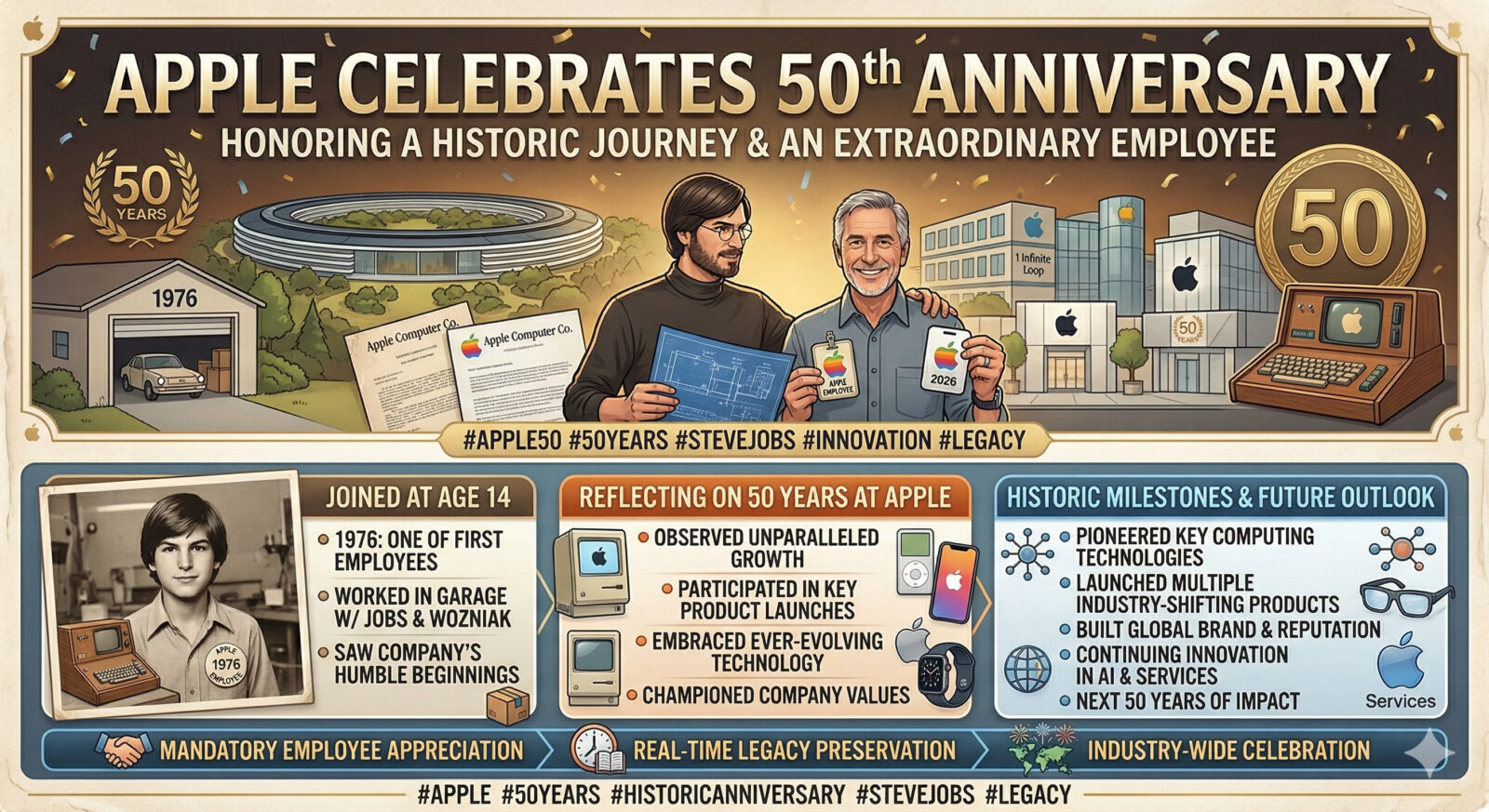
Apple Employee Who Joined at Age 14 Reflects on 50 Years at Apple as Company Celebrates Historic Anniversary
Chris Espinosa, Employee #8, has been inside Apple since before the personal computer existed. Now, as Apple turns 50, he’s finally telling the whole story. And it’s nothing like what you’d expect.
50 Years at Apple
1976 → 2026
In April 1976, a 14-year-old kid named Chris Espinosa hitched rides to Homebrew Computer Club meetings because his mother had grown tired of driving him. He’d started hanging around with two guys from Homestead High School, Steve Jobs and Steve Wozniak, against the explicit warnings of his teachers. And that summer, he quietly became Apple Computer’s eighth employee.
Fifty years later, he still is.
That’s it. That’s the story in two sentences. Exceptthatd this is the part nobody’s writing abo,ut those 50 years weren’t a single continuous arc of loyalty and comfort. They were a masterclass in institutional survival, creative reinvention, and the strange physics of what happens when you outlast everyone around you. As Apple celebrates its 50th anniversary in April 2026, I want to go deeper than the heartwarming headline. Because what Espinosa actually lived through is weirder, more human, and more instructive than any anniversary retrospective has bothered to tell.
🔍 Quick Answer: What You’re Looking For
Chris Espinosa is Apple’s longest-serving employee, officially designated Employee #8, who joined Apple in 1976 at the age of 14 hired directly by Steve Jobs to write software for the Apple I. As of Apple’s 50th anniversary in April 2026, Espinosa has worked at the company continuously for half a century, currently serving on the tvOS team. He is the only person employed by Apple throughout its history, having survived every leadership transition, layoff cycle, and product pivot.
50 Years Employed at Apple
#8
Official Apple
Employee Number
14
Age When
He Was Hired
$114M
Est. Value of Wozniak’s
Gift Shares Today
The 1976 Garage That Changed Everything And the Teenager Inside It
Let’s set the scene properly, because most coverage skips it. April 1, 1976: Apple Computer is incorporated. The computer industry as we understand it does not exist yet. There are no computer stores. There are no commercial software companies. There is no internet. There are brilliant, strange, obsessive people who build circuit boards in garages and trade programs in envelopes at club meetings.
Chris Espinosa was one of those people. Born in 1961, he was the kid in the room who shouldn’t have been there. He met Jobs at Paul Terrell’s Byte Shop, the first computer retailer in history, while Jobs was installing an Apple I. He befriended Wozniak, which meant late nights, strange conversations, and a front-row seat to the birth of something nobody had yet named.
His first job? Writing BASIC programs in the Jobs family garage and demonstrating the machines to potential customers. He was 14. He was, depending on your point of view, either the luckiest teenager in California or a kid who had absolutely no idea what he was walking into.
“It was really, really fun, because that was the time when people were starting the entire industry from scratch. Whether computer stores or commercial software all of these things had to be invented.”Chris Espinosa, to The New York Times, April 2026
Here’s the thing competitors’ articles miss: the significance of Espinosa’s employee number isn’t what you think. According to the Computer History Museum’s April 2026 retrospective, Apple’s early employee numbers were assigned for payroll by the company’s first CEO, Michael Scott, not in strict order of hiring. So Espinosa’s “#8” status doesn’t mean he was the eighth person through the door. It means he was among a core group of individuals, alongside Steve Jobs (#2) and Steve Wozniak (#1), who collectively assembled the scaffolding of what would become a $4 trillion corporation.
That’s a different kind of significance. And it’s one Espinosa has had 50 years to think about.
What the “Garage Era” Actually Felt Like
We romanticize the garage. We picture inspiration and freedom and late-night eureka moments. Espinosa’s accounts across a landmark Stanford University oral history interview and his recent New York Times profile describe something messier and more electric. He and other early Apple employees literally slept under their desks. The first machines were bizarre, hand-built objects that most people didn’t know what to do with. Selling an Apple I required explaining what a computer was.
Espinosa remembers wearing new corduroy pants to the West Coast Computer Fair in 1977, Apple’s first major public debut, because board chair Mike Markkula had coached the team to project the impression of a successful company. The booth was polished. The product was revolutionary. And somewhere in that booth, a teenager in new corduroys was helping explain to bewildered visitors why they might want to own a machine that cost $1,298 and required them to supply their own monitor and keyboard.
That moment people suddenly realizing they could have computing power all to themselves was, in Espinosa’s telling, like an explosion. Not a slow burn. An explosion. Worth keeping in mind the next time someone claims that tech disruption is a new phenomenon.
The Four-Stage Career Model: How Espinosa Survived (And Thrived) for Half a Century
Here’s the question everyone’s dancing around but not answering: How does someone actually do this? Staying at one company for 50 years in Silicon Valley the most job-fluid ecosystem on earth, isn’t just unusual. It borders on the statistically impossible. The median tenure at a major tech company is currently around 2–3 years. At Apple specifically, it’s been reported at roughly 1.8 years. Espinosa has beaten that median approximately 28 times over.
Looking at his career arc, a four-stage model emerges. This isn’t a framework he articulated it’s a pattern you can reverse-engineer from 50 years of institutional survival.
Stage 1 – Foundational (1976–1984): Building What Didn’t Exist
Espinosa’s early work was literal worldbuilding. He wrote software for machines that had no software ecosystem. He authored the Apple II user manual while still technically a part-time student at UC Berkeley before he could legally drive a car. When he was “talked into dropping out” by Steve Jobs in 1981 (a decision Jobs apparently made seem inevitable rather than coercive), Espinosa returned full-time at 19 to help shape what became the defining documentation and software culture of the Apple II era. The lesson: build something genuinely foundational and the company can’t unwind you from its DNA.
Stage 2 – Creative Friction (1982–1984): The Calculator Standoff
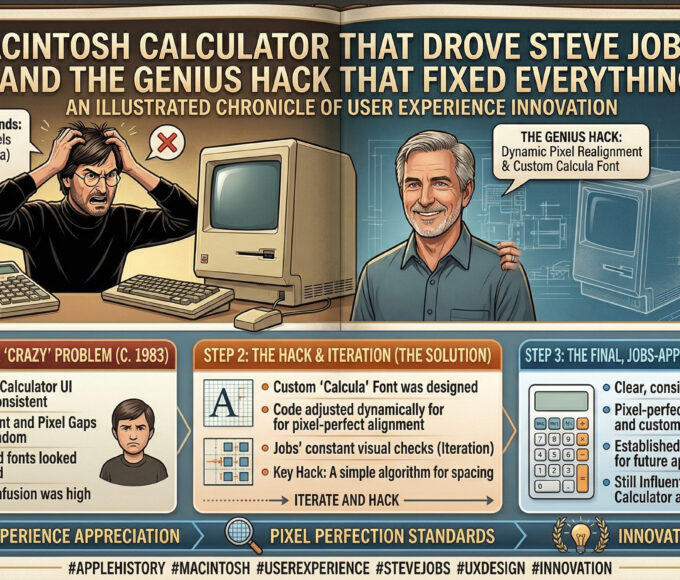
In 1982, Espinosa was tasked with designing the calculator application for the original Macintosh. Jobs famously hated every iteration too boxy, wrong button sizes, bad line weights. Rather than burning out in an endless feedback loop, Espinosa built what he called the “Steve Jobs Roll Your Own Calculator Construction Set” a real-time customization tool that let Jobs manipulate visual parameters directly. In about ten minutes, Jobs used it to design the calculator he wanted. The confrontation became collaboration. The lesson: when you can’t satisfy someone’s taste, give them the tools to express it themselves.
Stage 3 – Institutional Anchor (1985–1997): Surviving the Wilderness Years
This is the part of the story that gets the least airtime. After Jobs was ousted in 1985, Apple entered what Espinosa himself calls an era of “arrogance.” The company laid off staff “again and again and again” sometimes hundreds at a time, sometimes thousands. Espinosa was protected by a grimly funny mechanism: his severance package, earned through so many years of service, had become too expensive to trigger. His manager told him directly. He was job-safe not because he was untouchable, but because firing him cost more than keeping him.
“I was wondering what I was going to do,” he told the Times, “because I had no college degree and I had only worked at one company.” That sentence from someone with a net worth that likely includes Apple stock worth tens of millions is its own kind of education. The lesson: longevity creates its own protection, but it also creates its own vulnerability. Espinosa was protected and trapped simultaneously.
Stage 4 – Reinvention (1997–Present): Jobs Returns, and So Does Purpose
When Jobs came back with the acquisition of NeXT in 1997, Espinosa expected more volatility. What he found was different. Jobs had changed. He was, in Espinosa’s assessment, a leader who had learned. The subsequent reinvention iMac in 1998, iPod in 2001, iPhone in 2007, iPad in 2010 gave Espinosa new platforms to contribute to. He has worked across product documentation, marketing, developer relations, and most recently the tvOS team. The lesson: the best institutional survivors aren’t people who cling to one role. They’re people who can identify where the company’s energy is going next and show up there.
The Great Myth of Silicon Valley Loyalty And Why Espinosa Breaks Every Rule
Let me be honest about something: most “longevity at one company” stories are quiet tales of someone who found a comfortable corner and stayed in it. Espinosa’s story is almost the opposite. And it demolishes three myths that Silicon Valley tells itself about work, loyalty, and career building.
Myth #1: “Job-hopping is the only way to grow in tech.”
Conventional wisdom says you need to change companies every 2–3 years to grow your compensation, broaden your skills, and stay relevant. And statistically, for most people, that’s probably true. The research from the U.S. Bureau of Labor Statistics consistently shows that job-switchers outperform job-stayers in wage growth over 5-year windows.
But Espinosa’s case reveals a different calculus available to the very early or very foundational. The 2,000 Apple shares that Steve Wozniak gave Espinosa shortly after Apple’s IPO in 1980 as part of what became known as the “Woz Plan” to reward early employees, would now be worth approximately $57,000 each, for a combined estimated value of around $114 million. No amount of strategic job-hopping replicates that outcome.
Myth #2: “You need a college degree to succeed in tech.”
Espinosa doesn’t have one. He attended UC Berkeley, worked part-time for Apple, wrote the Apple II user manual, and then dropped out when Jobs convinced him to return full-time. His career disproves the credential thesis but with an important asterisk. He got his break in 1976, when there were no formal computer science departments to speak of. The industry was being built by people who didn’t have degrees because the degrees didn’t exist yet. Replicating that entry point today is not straightforward.
Myth #3: “Big tech companies are soul-crushing and transactional.”
Espinosa directly challenges this but not with the syrupy version. His assessment of Apple’s dark years is clear-eyed: arrogance, repeated layoffs, a culture that lost its way after Jobs left. He doesn’t romanticize it. What he describes instead is something more nuanced: a company whose worst periods were recoverable because its core purpose building tools that felt genuinely different, survived the organizational chaos.
📊 Comparison: Typical Tech Career vs. Espinosa’s Career
The average Silicon Valley engineer changes employers every 1.8–2.5 years and works at 12–15 companies across a 40-year career. Espinosa has worked at exactly one company across a 50-year career, accumulating institutional knowledge, equity, and access that no amount of strategic job-hopping could have replicated.
| Dimension | Average Tech Career | Espinosa’s Path |
|---|---|---|
| Companies worked at | 12–15 over 40 years | 1 over 50 years |
| Median tenure per role | 1.8–2.5 years (BLS, 2024) | 50 years (same company, multiple roles) |
| Primary wealth driver | Salary increases via switching | Early equity (Wozniak’s gift shares, IPO) |
| Identity & knowledge | Portable, cross-company | Deeply institutional, irreplaceable |
| Risk profile | Dispersed across employers | Concentrated protected by severance cost |
| Legacy | Broadly distributed contributions | Singular thread through entire company history |
What 50 Years Inside Apple Reveals About the Company Itself
Here’s something the anniversary profiles keep missing: Espinosa isn’t just a human-interest story. He’s a primary source. He’s the institutional memory for an organization that has, in various phases, been terrible at preserving its own history. What he says about Apple tells us something the company’s own PR machinery can’t.
On Apple’s Culture of Fear and Pride
At the Computer History Museum’s packed 50th anniversary event in March 2026, Espinosa was asked what single thread ties Apple’s entire story together. He didn’t hesitate: fear and pride. Apple, he said, was always terrified of being outpaced and always proud of doing things differently. That combination, not any particular product or leader, is what made the company durable.
Think about that framing. Not vision. Not innovation. Not disruption the word that Silicon Valley has turned into a costume. Fear and pride. One keeps you from getting comfortable. The other keeps you from compromising. Espinosa’s 50-year vantage point suggests these aren’t bugs in Apple’s culture. They’re load-bearing structures.
On Steve Jobs – The Complicated Truth
Espinosa’s portrait of Jobs is the most honest one available, because he watched Jobs across multiple phases: the raw, unformed genius of the garage years; the charismatic and sometimes ruthless leader of the early Apple; the “pest” (Espinosa’s word, referencing how many viewed Jobs before he latched onto the Mac project); and finally the returned, wiser leader after NeXT. Espinosa said Jobs “inspired fierce loyalty even when he made life difficult” and then gave the specific example of Jobs hiring him to lead Mac publications while secretly planning to fire Espinosa’s mentor, Jef Raskin.
That’s not hagiography. That’s a witness account. The difference matters.
On Apple Today
Espinosa’s most pointed contemporary observation doesn’t mention a product or a person. It’s this: “So much of tech is now just seeking the next bubble and getting out before it pops. That’s not what we do here.”
He’s describing a Silicon Valley culture built around acquisition, IPO, and exit and explicitly contrasting it with Apple’s 50-year model of building things for the long term. Coming from an employee who has watched Apple from the inside for its entire existence, that’s not corporate cheerleading. It’s a genuine comparative observation.
For context: as of 2026, Apple is approaching a $4 trillion market cap, ships 220 million iPhones annually, and generates approximately $1 million in revenue every 90 seconds. Nearly 2.5 billion people on the planet carry an Apple device. Whatever Espinosa’s company has been doing for 50 years it’s working.
The Full Timeline: 50 Years in Chris Espinosa’s Own Words
1976
Employee #8 Part-Time, Age 14
Joins Apple on a part-time basis. Writes BASIC programs for Apple I computers in Steve Jobs’ garage. Demonstrates machines to potential customers at Paul Terrell’s Byte Shop.
1977
The West Coast Computer Fair
Stands in Apple’s “slickest booth” at the fair in new corduroy pants. Witnesses what he later describes as the explosion of public interest in personal computing.
1978–1981
UC Berkeley – Sort Of
Takes a hiatus to study at Berkeley. Continues working part-time for Apple. Authors the Apple II user manual before he can legally drive. Eventually drops out after Jobs personally convinces him to return full-time.
1982–1984
The Macintosh Calculator and the Famous “Kit”
Tasked with designing the Mac calculator. Invents the “Steve Jobs Roll Your Own Calculator Construction Set” to resolve endless design disagreements with Jobs. Jobs uses it to design the final version in ten minutes.
1985–1997
The Wilderness Surviving Apple’s Dark Years
Jobs is ousted. Apple enters repeated layoff cycles. Espinosa survives because his severance package has become too expensive to execute. Describes this era as one of “arrogance” that nearly cost Apple everything.
1997
Jobs Returns and Things Change
Apple acquires NeXT. Jobs returns. Espinosa calls this a “cusp” and says this version of Jobs was different. Wiser. What follows: iMac, iPod, iTunes, the full reinvention.
2007
The iPhone Moment
Espinosa is in the audience for Jobs’ original iPhone keynote. He says the first moment he understood its full significance was receiving a text from his wife afterward that simply read: “I want.”
2011–Present
The Tim Cook Era – Continuity and Transition
Jobs passes away. Innovation shifts from blockbuster hardware launches to global software and services. Espinosa continues contributing currently on the tvOS team.
April 2026
Apple Turns 50. Espinosa Is Still There.
Apple celebrates its 50th anniversary with campus events, a Paul McCartney concert for employees, and a Tim Cook letter to staff. Espinosa gives a landmark NYT interview and appears at the Computer History Museum. He is the only person to have been at Apple for its entire existence.
Why This Story Matters Beyond the Nostalgia What Every Professional Can Learn
I’ll be upfront: I’m skeptical of “lessons from X” articles that turn complex lives into neat takeaways. Espinosa’s story isn’t a productivity framework. It’s a life. And lives don’t optimize cleanly.
But there’s something here that’s worth sitting with, especially if you’re earlier in your career and trying to figure out what kind of professional you want to be.
Longevity and depth aren’t consolation prizes for people who couldn’t get out. For a certain kind of person someone genuinely driven by the work, not the optics of career moves, staying deeply in one place produces something that mobility simply cannot: a perspective that nobody else has. Espinosa knows things about Apple that no amount of interviewing, researching, or data-gathering could surface. He was there. He wrote code on machines that no longer exist. He sat in meetings where the personal computer was being invented in real time. That knowledge is non-transferable. It lives in him.
There’s also a more uncomfortable truth in his story. He survived Apple’s darkest periods not through exceptional performance his own account acknowledges that but through a combination of institutional inertia, the prohibitive cost of his severance, and genuine irreplaceability born of depth. Systems protect the deeply embedded. That’s useful to understand, whether you’re deciding to stay somewhere or leave.
“I was here when we turned the lights on. I might as well stick around until we turn the lights off.” Chris Espinosa
And then there’s this: at the Computer History Museum event, when asked what drives him, Espinosa didn’t talk about stock price or market cap or legacy. He talked about the work. The creating. The fact that he started at 14 not because he was thinking about career paths or compensation — he was too young for any of that but because the work was genuinely, completely fascinating.
That’s the thread. Not loyalty. Not strategy. Fascination.
Frequently Asked Questions
Who is Chris Espinosa and why is he significant?
Chris Espinosa is Apple’s Employee #8 and the company’s longest-serving employee by a substantial margin. He joined Apple in 1976 at age 14 hired by Steve Jobs to write software for the Apple I, and has remained at the company continuously for 50 years. He is the only person who has worked at Apple for its entire existence, making him a living primary source for five decades of Silicon Valley history.
What does Chris Espinosa do at Apple today in 2026?
As of April 2026, Espinosa works on Apple’s tvOS team. His career at Apple has spanned dozens of roles over 50 years, including early software engineering, writing the Apple II user manual, designing the Macintosh calculator application, serving as System 7 marketing manager, and various roles in developer relations and product development.
How much are Chris Espinosa’s Apple shares worth?
The 2,000 Apple shares Steve Wozniak gave Espinosa shortly after Apple’s 1980 IPO as part of the “Woz Plan” to reward early employees would be worth approximately $57,000 each as of 2026, for a combined estimated value of around $114 million. This is separate from any additional equity Espinosa may have received over 50 years of employment.
Why did Chris Espinosa never leave Apple?
Espinosa’s own accounts suggest several overlapping factors: a genuine, sustained fascination with the work; the financial protection of significant early equity; the practical protection of an expensive severance package during Apple’s layoff-heavy years; and the professional reality of having no college degree and only one employer on his CV. But he’s also described something simpler he simply never found a reason compelling enough to leave.
What was the “Steve Jobs Calculator Kit” that Espinosa invented?
In 1982, Espinosa was tasked with designing the calculator application for the original Macintosh. Jobs repeatedly rejected his designs. Rather than continuing an endless iteration loop, Espinosa built a customization tool informally called the “Steve Jobs Roll Your Own Calculator Construction Set” that let Jobs directly manipulate visual parameters like button size and line thickness. Jobs used it to design the final calculator in approximately ten minutes.
What is Apple’s 50th anniversary and how is it being celebrated in 2026?
Apple was founded on April 1, 1976, making April 1, 2026, its 50th anniversary. The company celebrated with campus events including a Paul McCartney concert for employees, a commemorative letter from CEO Tim Cook, anniversary content on Apple’s website, and public events including a Computer History Museum retrospective featuring Espinosa and other Apple veterans. Tech journalist David Pogue also published a 608-page book titled “Apple: The First 50 Years” to mark the milestone.
What was Apple’s employee number system and what does #8 mean?
Apple’s early employee numbers were assigned by the company’s first CEO, Michael Scott, for payroll purposes not strictly in order of hiring. Espinosa’s designation as Employee #8 places him among the company’s foundational inner circle, which included Steve Wozniak (#1), Steve Jobs (#2), investor Mike Markkula (#3), and hardware engineer Rod Holt (#5).


Leave a comment