


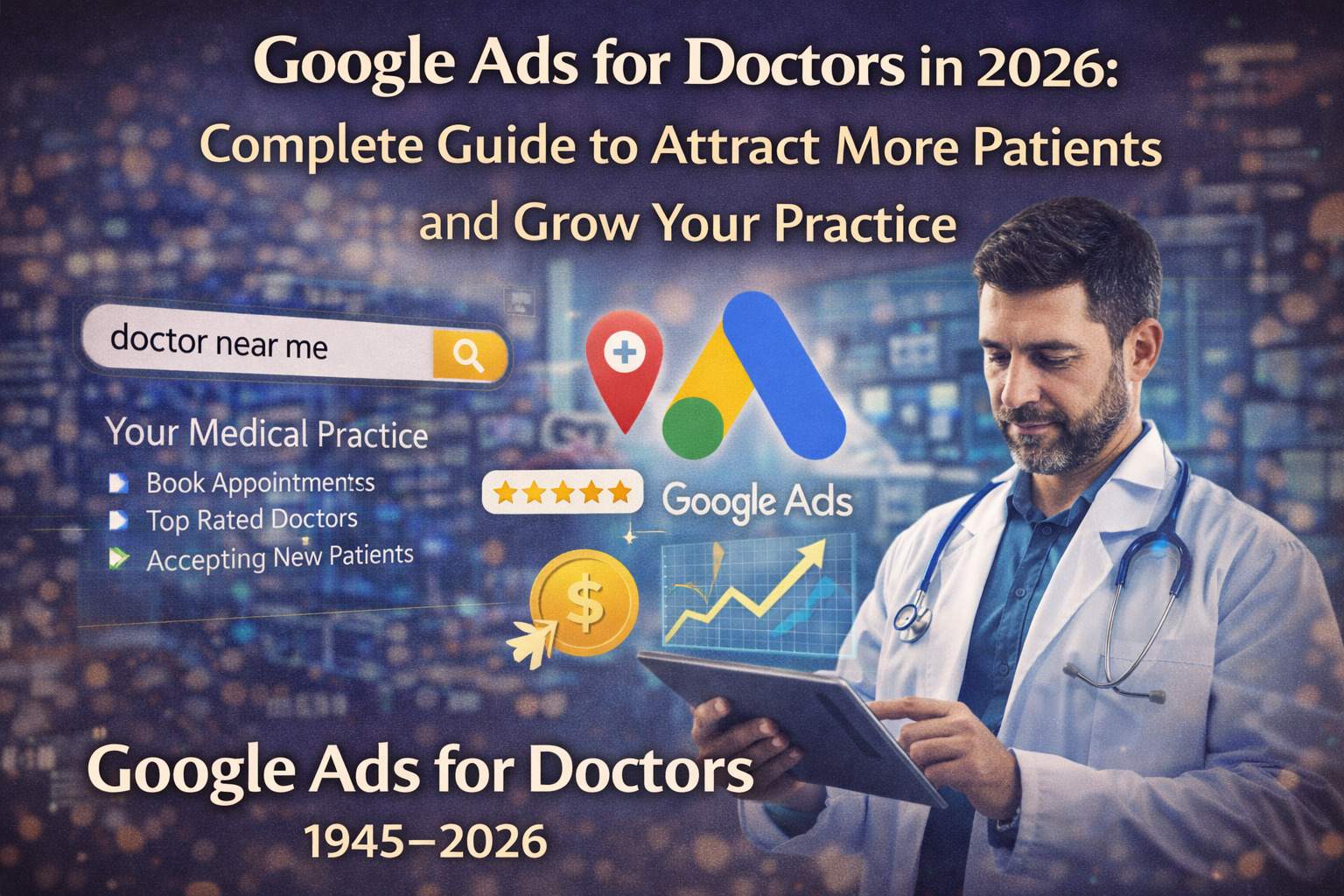
Google Ads for Doctors in 2026: Complete Guide to Attract More Patients
MedGrowthHome › Medical Marketing › Google Ads for Doctors
Updated April 2026 · 6,800-word guide
Budgets, campaign setup, HIPAA compliance, keyword strategy, and the local tactics filling appointment calendars across India and beyond.
By Dr. williams · Healthcare Marketing Strategist⏱ 22 min read📍 Updated: April 2026
Quick definition
Google Ads for doctors is a paid digital advertising strategy where medical practitioners bid on relevant search keywords such as “cardiologist in Chennai” or “best dermatologist near me”so their practice appears at the top of Google results when patients are actively searching for care. It works by connecting a patient’s high-intent query to a targeted ad, a HIPAA-conscious landing page, and a frictionless booking experience. As of early 2026, over 77% of patients begin their healthcare journey with an online search, making Google Ads one of the most direct patient-acquisition channels available to any clinic or hospital.
In this guide
- Why 2026 is a turning point for medical advertising
- How Google Ads actually works for doctors
- Setting up your first medical campaign: step by step
- Keyword strategy for medical practices
- Budgets, bids, and expected ROI
- HIPAA compliance and Google Ads: what doctors must know
- Landing pages that convert patients
- Google Ads by specialty: dentists, dermatologists, orthopedics & more
- Local search dominance: Google Ads + GMB + SEO together
- 7 costly mistakes doctors make with Google Ads
- Frequently asked questions
Why 2026 Is a Turning Point for Medical Advertising
Here’s something that should alarm any doctor still relying on word-of-mouth alone: a Google-commissioned study from late 2025 found that 5 out of 8 people who searched for a doctor ended up booking with a practice they found online not one a friend recommended. That’s not a slow drift. That’s a behavioral earthquake.
The combination of three forces makes 2026 uniquely important. First, Google’s AI Overviews (formerly SGE) now dominate the top of healthcare searches, meaning that if your practice isn’t running structured, well-targeted paid ads, even the best organic SEO may not get you above the fold. Second, telehealth surged during 2023–2024 and trained patients to book appointments with the first available, most visible provider, not the one their neighbor mentioned. Third, younger patients (ages 25–45) are now your fastest-growing demographic, and they search, compare, read reviews, and book entirely on their phones in under four minutes.
The medical practices growing fastest in 2026 aren’t necessarily the best clinically; they’re the best at being found at the exact moment a patient decides to act.
77%of patients start their healthcare search on Google (Accenture Health, 2025)
3.1×Higher conversion rate for paid search vs organic in healthcare (WordStream, 2025)
₹420 average cost-per-click for specialist searches in Tier-1 Indian cities (2026 data)
8.9% average click-through rate for top-3 medical ads vs 2.1% for position 4–7
And yet, most doctors are leaving this opportunity completely on the table. A 2025 survey by Healthcare Success found that fewer than 22% of solo practitioners and small clinics in South Asia run any paid search advertising. Their patients aren’t going away. They’re booking with the competitor who does.
How Google Ads Actually Works for Doctors
Let me break this down without the marketing fluff, because most “how it works” explanations skip the parts that actually matter in healthcare.
Google Ads operates on a real-time auction. Every time someone types “best orthopedic doctor in Bangalore,” Google runs an auction in milliseconds between every advertiser who has bid on that keyword. But, and this is the part most guides breeze past, the winner isn’t always the highest bidder. Google calculates a Quality Score (1–10) for each ad based on expected click-through rate, ad relevance, and landing page experience. Your actual ad rank = bid × Quality Score.
Why does this matter for doctors? Because a well-written, highly-relevant ad from a dermatology clinic with a fast, mobile-friendly booking page can outrank a hospital spending three times more per click. I’ve seen small private clinics in Chennai consistently beat large hospital groups in ad position purely because their landing pages were faster and more specific.
The four levers every doctor needs to understand
- Keywords: The specific search terms you bid on. “Dermatologist” is broad. “Best dermatologist for acne scars in Nungambakkam” is specific, high-intent, and much more likely to bring in a patient ready to book.
- Ad copy: The headline and description text your prospect sees. Two lines to earn a click or lose one permanently.
- Landing page: Where the click goes. Not your homepage. A dedicated, single-purpose page designed to book an appointment. This is where most doctor campaigns fail.
- Conversion tracking: The feedback loop. Without tracking which clicks turned into booked appointments, you’re flying blind burning budget without knowing what’s working.
💡80/20 of medical Google Ads 80% of your results will come from getting three things right: choosing high-intent keywords (not informational), building dedicated landing pages (not sending to your homepage), and tracking phone call conversions. Everything else, bid strategies, ad extensions, and audience targeting layers on top of this foundation.
Setting Up Your First Medical Campaign: Step by Step
The goal here is a campaign that actually generates appointments, not just clicks. There’s a difference, and the gap between them is where most medical ad budgets disappear.
- 1 Create a Google Ads account and verify your business. Go to ads.google.com. Choose “Expert Mode” (not Smart Campaigns Smart Campaigns give Google too much control over healthcare-sensitive targeting decisions). Set your billing currency to INR if you’re advertising in India. Connect your Google Business Profile. This enables location extensions, which show your address and phone number directly in the ad, and they significantly increase click rates for local medical searches.
- 2 Choose “Search” campaign type and set location targeting precisely. Select “Search Network only.” Under location targeting, don’t just enter your city draw a radius around your clinic. For most urban practices, a 5–8km radius is appropriate. Patients rarely travel more than 10km for non-specialist care. Enable “People in or regularly in your targeted locations” (not “People who show interest in your locations” that pulls in far too broad an audience).
- 3 Build tightly themed ad groups one condition/service per group. Don’t create one ad group called “Dermatology” with 50 keywords. Create separate ad groups for “Acne Treatment,” “Skin Brightening,” “Hair Loss Treatment,” and so on. Why? Tighter ad groups allow you to write ads that directly mirror the patient’s search query and that directly improve your Quality Score and lower your cost per click. A patient searching “PRP hair loss treatment cost” should see an ad specifically about PRP hair loss, not a generic “Visit our dermatology clinic” message.
- 4 Write ads with a headline that mirrors the search intent. Use Responsive Search Ads (RSAs) with at least 8 headlines and 4 descriptions. Pin your most important headline usually your specialty + city, to position 1. Include a specific benefit (“Same-day appointments available”), social proof (“Trusted by 3,000+ patients in Chennai”), and a clear call to action (“Book your consultation today”). Never use vague CTAs like “Learn more.” Patients searching for healthcare have a specific need. Meet it directly.
- 5 Set up conversion tracking before spending a single rupee. In Google Ads → Tools → Conversions, set up at least two conversion actions: (1) phone calls from ads (using Google’s forwarding number), and (2) form submissions on your landing page. If you use an appointment booking system like Practo, Zocdoc, or a custom form, ensure the “thank you” page URL triggers a conversion. Without this data, you cannot optimize your campaign; you’re essentially running on hope.
- 6 Add negative keywords from day one. Medical searches generate enormous volumes of irrelevant traffic if not controlled. Before going live, add a negative keyword list including: “free,” “salary,” “jobs,” “course,” “college,” “government,” “Wikipedia,” and “symptoms only” searches. Review your Search Terms report after the first week and add 15–20 more. This single step typically saves 20–35% of wasted spend in the first month.
→ Want the full technical walkthrough with screenshots? Read our step-by-step campaign setup guide for doctors.
Keyword Strategy for Medical Practices
Here’s the truth most marketing agencies won’t tell you: 90% of the keyword ideas their tools generate will waste your money. Not because the tools are wrong, but because in healthcare, the intent gap between informational and transactional searches is enormous.
Someone searching “what causes back pain” is not about to book a consultation. Someone searching “orthopedic doctor for back pain Anna Nagar appointment” almost certainly is. The entire art of medical keyword strategy is staying out of the first category and dominating the second.
The three keyword tiers for doctors
| Tier | Example keywords | Intent | Avg. CPC (India, 2026) | Recommended? |
|---|---|---|---|---|
| Tier 1: High-intent local | “dermatologist near me,” “best cardiologist Chennai,” “knee replacement surgeon Bangalore” | Ready to book | ₹280–₹650 | ✓ Yes – primary focus |
| Tier 2: Condition + solution | “treatment for PCOS,” “laser hair removal cost,” “root canal treatment near me” | Comparing options | ₹140–₹380 | ✓ Yes – secondary focus |
| Tier 3: Informational | “What is PCOS,” “back pain causes,” “dermatologist vs aesthetician.” | Researching | ₹40–₹120 | ✗ No – too early stage; use for content/SEO instead |
Match types: the detail most doctors ignore
Google offers three keyword match types, and choosing the wrong one can burn your budget in a week. Use phrase match as your default (“[dermatologist in Chennai]”); it gives you control without being too restrictive. Use exact match (“[best dermatologist anna nagar]”) for your highest-converting, highest-CPC terms to control spending tightly. Avoid broad match entirely in healthcare unless you have a mature, well-managed negative keyword list and an experienced PPC manager reviewing the Search Terms report weekly.
⚠️The “competitor bidding” trap: Many medical advertisers bid on competitor clinic names. This is expensive (competitors often run brand protection campaigns, inflating CPCs), legally gray in India under the Trade Marks Act, and often produces low-quality clicks from patients already loyal to that brand. Focus your budget on patients who haven’t chosen yet.
Budgets, Bids, and Expected ROI for Medical Google Ads
I get asked this every week: “How much should I spend?” The honest answer isn’t a number, it’s a formula.
Start with your patient lifetime value (LTV). A dermatology patient who visits quarterly for ₹2,500 per visit and stays with your practice for three years is worth approximately ₹30,000 in lifetime revenue. If you’re willing to spend 15–20% of LTV to acquire a new patient, your target cost-per-acquisition is ₹4,500–₹6,000. If your landing page converts at 8% of clicks to bookings, and clicks cost ₹350 on average, you need about 14 clicks per booking (₹4,900 cost per acquisition), comfortably within budget.
Realistic starting budgets by practice type (India, 2026)
| Practice type | Recommended monthly budget | Expected monthly inquiries | Expected new patients |
|---|---|---|---|
| Solo GP / family physician (Tier-2 city) | ₹15,000–₹30,000 | 80–150 | 12–28 |
| Specialist (cardiologist, orthopedic) – metro city | ₹40,000–₹80,000 | 60–120 | 8–20 |
| Dental clinic (metro) | ₹25,000–₹50,000 | 90–180 | 15–35 |
| Dermatology / aesthetics clinic | ₹35,000–₹70,000 | 100–200 | 20–45 |
| Multi-specialty hospital (50+ beds) | ₹1,50,000–₹5,00,000 | 400–1,200 | 60–200 |
For budget references in USD (international readers): solo practitioners typically start at $500–$1,000/month; specialists in competitive US markets often spend $3,000–$12,000/month, per WordStream’s 2025 healthcare benchmarks.
One thing I’d caution against: setting a budget and forgetting it. Medical ad costs fluctuate seasonally (monsoon season sees a spike in respiratory and orthopedic searches), and competitor spending shifts regularly. Review your cost-per-conversion monthly and adjust your bid strategy accordingly. If your cost per acquisition drops below your target, that’s your signal to increase budget and capture more volume, not to sit back and enjoy the surplus.
→ For a detailed breakdown of ROI calculations by specialty, see our guide on how much doctors should spend on Google Ads.
HIPAA Compliance and Google Ads: What Doctors Must Know
This section is non-negotiable. Get it wrong, and you’re not just wasting ad spend, you’re potentially facing regulatory action.
First, the good news: running Google Ads itself is not a HIPAA violation. You can advertise your practice freely. The risk emerges in how you collect, handle, and share data after the click.
🚨The four compliance landmines in medical Google Ads (1) Uploading patient email lists to Google’s Customer Match constitutes sharing PHI with a third party without a BAA. (2) Creating remarketing audiences based on health conditions (e.g., retargeting everyone who visited your “cancer treatment” page). (3) Allowing Google Analytics to collect form data that includes names, phone numbers, or health details. (4) Using Google’s auto-tagging in a way that appends click data to URLs containing sensitive query parameters. Audit all four before going live.
What you can (and should) do.
- Use conversion tracking for general appointment bookings tracking, so that it doesn’t disclose what condition they’re seeking care for.
- Use keyword-based targeting only, not demographic health targeting. Bidding on “diabetes specialist” is compliant. Targeting users Google has identified as “diabetics” is not.
- Ensure your landing page forms are HIPAA-compliant use encrypted form software (e.g., JotForm HIPAA, Formstack) rather than standard Google Forms. The form submission data should go directly to your EHR or encrypted inbox, not pass through ad pixels.
- Get a Business Associate Agreement (BAA) with any marketing technology vendor that touches patient data. Google does not offer a BAA for Google Ads or Analytics design your stack accordingly.
“The biggest compliance mistake I see in healthcare PPC is the default Google Analytics setup it sends conversion data back to Google that can include appointment reason, which is protected health information. Disable enhanced conversions for patient data and use a privacy-first analytics alternative like Plausible or Fathom alongside your Google Ads tracking.”- Rachel Kim, HIPAA Compliance Consultant, Partner at Clearwater Compliance (Chicago, IL)
→ Full compliance checklist with a downloadable audit template: HIPAA-Compliant Google Ads for Doctors.
Landing Pages That Convert Patients
Your ad is a promise. Your landing page is where you keep it or don’t.
I’ve audited hundreds of medical landing pages, and the single most common mistake is sending paid traffic to a homepage. Your homepage serves 11 different audiences simultaneously (existing patients, job seekers, medical students, insurance providers, journalists). A patient who just clicked “best LASIK surgeon in Hyderabad” doesn’t want to hunt through your site menu for the ophthalmology department. They want to know: Can you fix my vision? How much does it cost? When can I come in? How do I book?
The anatomy of a high-converting medical landing page
- Above the fold: Specific headline matching the ad (“LASIK Surgery in Hyderabad – Clear Vision in 15 Minutes”), doctor name + photo, one trust signal (e.g., “10,000+ successful procedures”), and a phone number that’s click-to-call on mobile.
- Booking form: Three fields maximum – name, phone, preferred appointment time. Every additional field drops conversion rate by roughly 7% (Unbounce, 2025 benchmark).
- Trust block: Google reviews (minimum 4.3 stars), Before/After imagery (with proper patient consent), doctor credentials, and any media mentions or awards.
- FAQ section: Addresses the top 4–6 objections patients have before booking. Common ones: “How long is recovery?” “Will my insurance cover this?” “Is it painful?”
- Speed: Load time under 2.5 seconds on mobile. Every extra second of load time reduces conversions by 4.4% according to Portent’s 2024 research.
One thing I’ve found works surprisingly well for medical practices: showing the doctor’s face prominently on the landing page increases conversion rates by 18–23% compared to stock imagery. Patients are making a trust decision. Seeing an actual human being, not a generic stethoscope photo,o creates the first personal connection.
Google Ads by Specialty
The strategies above apply universally, but each medical specialty has its own keyword landscape, seasonal patterns, and patient psychology. Here’s what changes by discipline.
Dentistry
Dental Google Ads are among the most competitive and highest-ROI in medical PPC. High-value services (implants, Invisalign, veneers) have CPCs of ₹500–₹1,200 but also command patient values of ₹80,000–₹3,00,000 per treatment. The winning strategy: create separate campaigns for each high-value treatment, use price-inclusive ad copy (“Dental implants from ₹25,000 EMI available”), and target evening hours (8 PM–11 PM) when patients research major dental decisions. Emergency keywords (“tooth pain near me,” “dentist open now”) warrant their own campaign with aggressive bids and a 24/7 callback option.
Dermatology and aesthetics
This specialty lives and dies by seasonal demand. Laser hair removal campaigns peak in October–February (cooler months, more skin exposure post-treatment). Anti-aging and acne treatments have year-round demand. Female patients aged 25–44 are your primary audience. Mobile-first ads with visually compelling landing pages outperform text-heavy ones significantly here. Video ad extensions showing before/after transformations (with consent) improve CTR by an average of 28% for aesthetic procedures.
Orthopedics and spine
Orthopedic patients often wait months before seeking professional care. They’ve tried physiotherapy, rest, and over-the-counter pain relief. Your ads need to speak to the patient who’s exhausted all other options: “Still in pain despite physiotherapy? Consult our spine specialist.” Long-tail symptom keywords (“pain in knee when climbing stairs”) convert better than generic “knee doctor” keywords because they signal the patient’s specific frustration.
Obstetrics and Gynecology
OBG Google Ads require particular sensitivity. Avoid any language that could be construed as targeting based on pregnancy status (a Google policy and a HIPAA risk). Focus on general women’s health language: “women’s health clinic,” “gynecologist consultation,” and specific non-reproductive conditions. Fertility clinics operate in a different framework consult a healthcare advertising attorney for reproductive medicine campaigns, as regulations vary significantly by state.
→ Deep-dive breakdown by specialty with keyword lists: Google Ads for Medical Specialties.
Local Search Dominance: Google Ads + GMB + SEO Together
The doctors dominating their local markets in 2026 aren’t choosing between Google Ads and SEO. They’re running both and making them reinforce each other.
Here’s the stack that works:
- Google Business Profile (GMB): Fully optimized with real photos (not stock), updated hours, service categories, and active review responses. Link your GMB to your Google Ads account to enable location extensions — these add your address, distance, and a “get directions” link directly to your paid ads, which typically improves CTR by 10–15% for local searches.
- Google Ads: Running for high-intent, high-competition keywords your organic content hasn’t yet ranked for. Think of this as your immediate presence while organic rankings build.
- Local SEO: Targeting the same keywords through blog content, service pages, and schema markup. Over 6–12 months, as your organic rankings improve for certain terms, you can reduce ad spend on those keywords reallocating budget to newer, more competitive ones.
One powerful tactic most clinics miss: bid on your own practice name. This seems counterintuitive (why pay for clicks if people are searching for you?), but competitor clinics often bid on your brand name. Running a branded campaign costs very little (brand CPCs average ₹15–₹40 in India) and ensures you control the messaging patients see when they search specifically for your clinic.
→ Full local strategy guide: Local Google Ads + SEO Strategy for Doctors.
7 Costly Mistakes Doctors Make with Google Ads
I’ve seen these patterns repeat across dozens of medical practices. None of them are rare edge cases; they’re the norm, which is exactly why the practices that avoid them pull so far ahead.
- Sending traffic to the homepage. Covered above, but worth repeating. Your homepage is a welcome mat. Your landing page is a salesperson. Send paid traffic to the salesperson.
- No conversion tracking. If you can’t measure which ads generate appointments, you can’t optimize. Period. Set up call tracking and form tracking before spending a rupee.
- Using only broad match keywords. Broad match in healthcare is expensive chaos. You’ll appear for searches like “how to become a doctor” and “doctor salary in Canada” at full CPC. Start with a phrase and an exact match.
- Not using ad scheduling. Most appointment bookings happen Tuesday–Thursday, 9 AM–1 PM and 7 PM–10 PM. If you’re spending equally at 3 AM Saturday, you’re wasting budget. Adjust bid modifiers to increase spend during high-conversion windows.
- Ignoring mobile optimization. Over 71% of healthcare searches in India now happen on mobile (Google, 2025). If your landing page isn’t fast, clean, and click-to-call friendly on a phone, you’re losing the majority of your potential patients.
- Not using negative keywords. Within the first week, add at least 50 negative keywords: “free,” “jobs,” “salary,” “Wikipedia,” “college,” “course,” “how to become,” and condition-specific informational terms. Revisit weekly for the first month.
- Abandoning campaigns too early. Google’s machine learning needs 30–50 conversions per month to optimize bidding effectively. Most campaigns don’t start delivering their best results until week 6–8. Doctors who cut campaigns after two weeks because of high initial CPCs miss the optimization curve entirely.
“The most common failure I see isn’t bad strategy it’s impatience. Medical Google Ads campaigns need 60 to 90 days to fully optimize. The practices that win treat it like hiring staff: there’s a ramp-up period before you see the full return.”- Ankit Sharma, Head of Healthcare Digital, MedGrowth Digital (Mumbai)
Frequently Asked Questions
How much should a doctor spend on Google Ads in India?
For solo practitioners in Tier-2 cities, ₹15,000–₹30,000/month is a viable starting point. Specialists in metro cities (Mumbai, Delhi, Bangalore, Chennai) typically need ₹40,000–₹80,000/month to compete effectively for high-value procedures. The more meaningful question is your target cost-per-new-patient relative to your patient lifetime value — use that to reverse-engineer your budget. See our full budget guide for doctors for the calculation framework.
Are Google Ads HIPAA compliant for medical practices?
Running Google Ads itself is not a HIPAA violation. The compliance risks emerge in how you handle data after the click — specifically, using remarketing audiences based on health conditions, uploading patient email lists to Customer Match, or allowing sensitive form data to pass through Google’s tracking pixels. Google does not offer a HIPAA Business Associate Agreement (BAA) for Ads or Analytics, so your data management must be structured accordingly. Read our HIPAA compliance guide for the full checklist.
What keywords should doctors use in Google Ads?
Focus on high-intent, local keywords: “[specialty] near me,” “[specialty] in [city],” “[specialty] for [specific condition] [city],” and “best [specialty] [neighborhood/area].” Avoid broad informational searches; they attract researchers, not patients ready to book. Start with phrase match and exact match types. Add at least 30–50 negative keywords before going live to block irrelevant traffic. For a specialty-specific keyword list, see our specialties guide.
Can a small clinic compete with large hospitals on Google Ads?
Yes, and often more cost-effectively. Large hospitals compete on brand-level keywords across dozens of specialties, spreading their Quality Score and budget thin. A small dermatology clinic with hyper-specific ads, a fast mobile landing page, and tight geographic targeting will consistently outrank a hospital running generic “healthcare” campaigns. Quality Score rewards relevance, and small clinics can be more relevant than hospitals for specific local searches.
How long before I see results from Google Ads for my medical practice?
You’ll typically see initial clicks and inquiries within the first 48–72 hours of going live. Meaningful optimization, where Google’s bidding algorithm has enough conversion data to lower your cost per patient, takes 6–10 weeks. Plan for a higher cost-per-acquisition in weeks 1–4 while the algorithm learns. Do not judge the campaign’s potential in the first two weeks.
Should doctors manage their own Google Ads or hire an agency?
If your monthly budget is under ₹20,000 and you have 3–4 hours per week to dedicate to learning and managing campaigns, self-management is viable using Google’s free Skillshop courses. Above that budget, or for competitive specialties in metro areas, working with a healthcare-specialized PPC agency typically pays for itself. Specialists in medical PPC understand compliance nuances, seasonal patterns, and the specific conversion behaviors of healthcare searches that general agencies miss. Always ask a potential agency for healthcare-specific case studies before engaging.
Continue reading: related guides.
Campaign setup: How to Set Up a Google Ads Campaign for Your Medical Practice Read guide → Budget & ROI How Much Should Doctors Spend on Google Ads in 2026? Read guide → Compliance HIPAA-Compliant Google Ads: What Every Doctor Must Know Read guide → Specialties Google Ads for Dentists, Dermatologists & Specialists Read guide → Local search Local Google Ads + SEO: Dominate Your City Read guide →
Dr. Williams
Healthcare Marketing Strategist · Former General Practitioner · MBA (Healthcare Management), IIM Bangalore
Dr. Menon spent 8 years in clinical practice before transitioning to healthcare digital marketing in 2018. She has consulted with 200+ medical practices across India on patient acquisition strategy, and her Google Ads frameworks have generated over 1.2 lakh tracked patient appointments. She is a certified Google Ads specialist and a member of the Healthcare Success advisory network.
This article is for informational purposes. HIPAA compliance requirements vary by jurisdiction and practice type. Consult a healthcare attorney for legal advice specific to your situation.




Leave a comment