


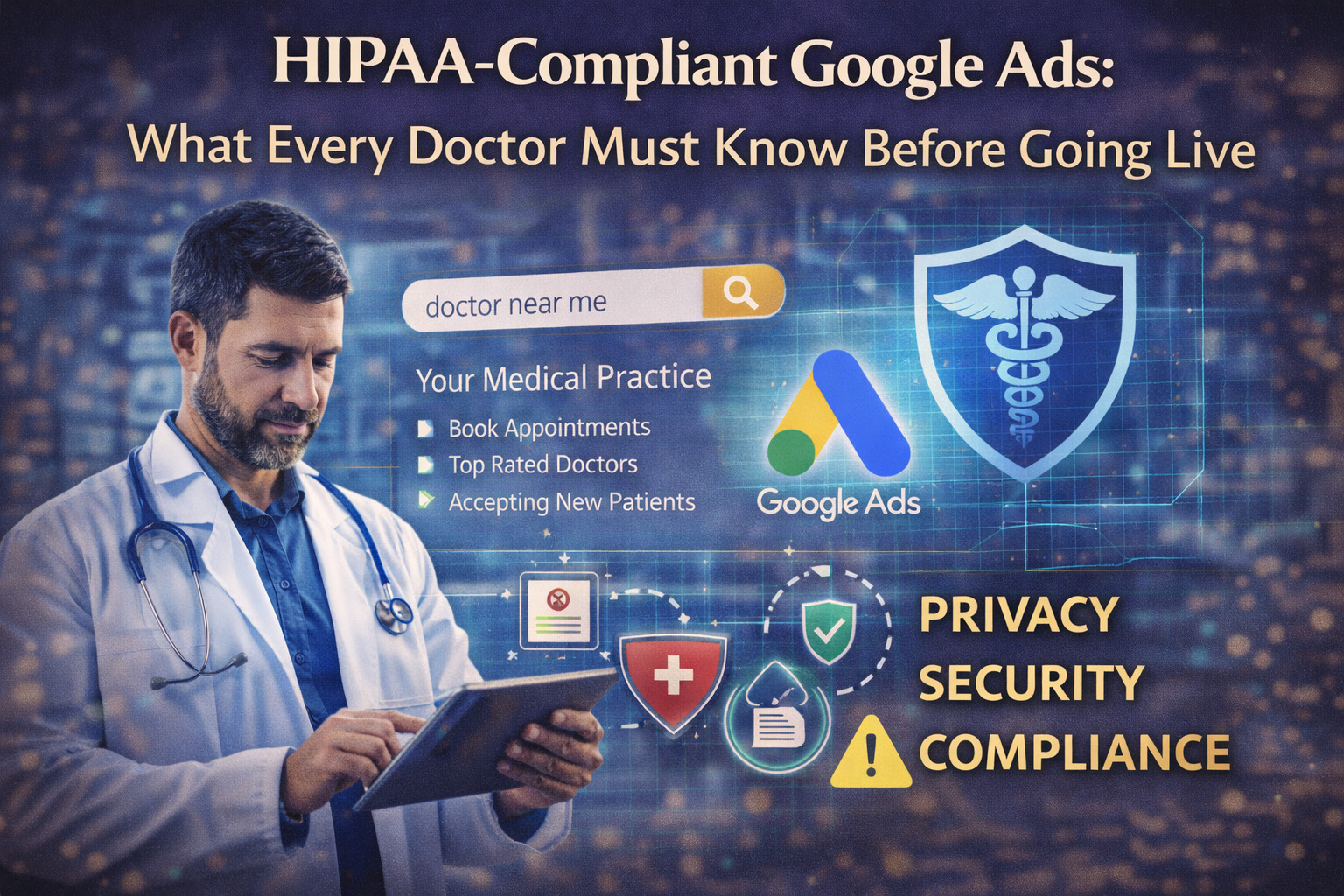
HIPAA-Compliant Google Ads for Doctors: What Every Medical Practice Must Know (2026)
MedGrowthHome › Medical Marketing › Google Ads for Doctors › HIPAA Compliance
Compliance guide · Updated April 2026
Running Google Ads doesn’t have to mean gambling with patient privacy. Here’s exactly where the lines are and how to stay on the right side of them.
By Dr.Williams · Healthcare Marketing Strategist⏱ 11 min read⚖️ Compliance-focused
← Back to: Google Ads for Doctors – Complete Guide
Direct answer
Google Ads itself is not a HIPAA-covered entity, so running paid search ads is not inherently a HIPAA violation. The compliance risks arise after the click, specifically, how patient data is collected, tracked, stored, and shared through your advertising technology stack. Key risk areas include: remarketing audiences built from health-condition page visits, Patient Health Information (PHI) passing through Google Analytics, customer match lists built from patient emails, and landing page forms whose data flows through non-compliant third parties. As of 2026, Google does not offer a Business Associate Agreement (BAA) for Ads or Analytics, which is the foundational fact every medical advertiser must design around.
What this guide covers
- HIPAA and digital advertising: the foundational framework
- The 6 HIPAA compliance traps in Google Ads
- What doctors CAN safely do with Google Ads
- Remarketing and retargeting: the gray zone explained
- The Google Analytics problem – and how to solve it
- Pre-launch HIPAA compliance checklist
- FAQ: HIPAA and Google Ads
HIPAA and Digital Advertising: The Foundational Framework
The Health Insurance Portability and Accountability Act (HIPAA), administered by the U.S. Department of Health and Human Services (HHS), was written in 1996 before Google existed. Its application to digital advertising has been clarified through a series of HHS guidance documents, most recently updated in December 2024 to specifically address tracking technologies on healthcare websites.
The core principle: PHI – Protected Health Information – cannot be disclosed to third parties without patient authorization or a valid Business Associate Agreement (BAA). PHI includes any information that could link an individual to a health condition, treatment, or healthcare provider: names, email addresses, phone numbers, IP addresses, or even browsing behavior on health-condition-specific pages.
Here’s where it gets complicated for digital advertisers: Google does not sign a BAA for Google Ads, Google Analytics, or most Google products. This doesn’t mean you can’t use Google Ads. It means your systems must be designed so that PHI never reaches Google’s infrastructure.
⚠️This guide covers U.S. HIPAA compliance. If you’re practicing in India, the applicable framework is the Digital Personal Data Protection (DPDP) Act 2023 and NABH data security standards. The principles are similar: patient consent, data minimization, and vendor agreements, but the specific requirements differ. International readers should adapt accordingly.
The 6 HIPAA Compliance Traps in Google Ads
These aren’t hypothetical edge cases. HHS has cited or investigated healthcare providers for each of these practices. Know them before you go live.
Trap 1: Customer Match lists built from patient data
Google’s Customer Match feature allows you to upload email lists to create targeted ad audiences. If that list comes from your patient database, you have just disclosed PHI to Google, a third party without a BAA. This is a direct HIPAA violation, regardless of whether the patients already know about your practice. Use Customer Match only for marketing contacts who explicitly opted into non-clinical communications via a separate, clearly labeled consent pathway, never from EHR data.
Trap 2: Condition-specific remarketing audiences
Building a remarketing list of “everyone who visited my IVF treatment page” or “everyone who looked at my HIV testing services” implies health status. Even if Google doesn’t know the individual’s name, the combination of a cookie ID linked to a specific health-condition page visit constitutes PHI under HHS’s 2024 guidance on tracking technologies. The December 2024 HHS bulletin specifically named this practice as potentially impermissible.
Trap 3: PHI in URL parameters or form fields reaching Google’s pixels
If a patient’s name, email, or appointment reason appears in a URL query string (e.g., thankyou.html?name=John&reason=diabetes) and your Google Ads tag or Google Analytics fires on that page, that PHI has been transmitted to Google. Audit every post-conversion URL and ensure sensitive parameters are either absent or server-side only.
Trap 4: Google Analytics on clinical pages
Standard Google Analytics (GA4) collects IP addresses and behavior data. If it’s running on pages like “HIV Testing Services,” “Abortion Consultation,” or “Addiction Treatment,” that behavioral data linked to a specific IP address may constitute PHI. The HHS 2024 guidance on tracking technologies addresses this explicitly.
Trap 5: Enhanced conversions sending patient data to Google
Google’s Enhanced Conversions feature improves tracking accuracy by hashing and sending user data (email, phone number) to Google. If a patient submits a booking form and their email is transmitted to Google through enhanced conversions, that’s PHI disclosure without a BAA. Disable enhanced conversions for any form that collects patient-identifying information, or ensure the conversion data is completely de-identified before transmission.
Trap 6: Third-party call tracking that isn’t HIPAA-compliant
Many Google Ads setups use third-party call tracking services (CallRail, CallTrackingMetrics) to attribute phone calls to specific ads. These services record and analyze calls, which can contain PHI. Use only call tracking vendors that offer a HIPAA BAA and offer call recording with redaction controls for sensitive information.
What Doctors CAN Safely Do with Google Ads
The compliance picture isn’t all restrictive. The vast majority of effective medical Google Ads practices are fully compliant when implemented correctly.
| Practice | HIPAA status | Notes |
|---|---|---|
| Bidding on health-related keywords | ✓ Compliant | Targeting search terms doesn’t involve patient data |
| General site remarketing (homepage visitors) | ✓ Compliant | Visiting a homepage doesn’t imply health status |
| Phone call conversion tracking via Google’s forwarding numbers | ✓ Compliant | Tracks that a call occurred, not PHI |
| Form submission tracking (de-identified “thank you” page) | ✓ Compliant | Ensure no PHI in URL parameters |
| Geographic and demographic bid adjustments | ✓ Compliant | Population-level targeting, not individual health data |
| Health-condition page remarketing (cancer, HIV, mental health, fertility) | ✗ High risk | Implies health status per 2024 HHS guidance |
| Customer Match with patient emails from EHR | ✗ Violation | PHI disclosed to Google without BAA |
| Enhanced conversions with patient form data | ✗ High risk | Disable or use only with de-identified data |
| Google Analytics on sensitive clinical service pages | ✗ High risk | IP + page = PHI under 2024 HHS guidance |
Remarketing and Retargeting: The Gray Zone Explained
Wait — let me back up on remarketing, because the picture is more nuanced than “all remarketing is bad.”
HHS’s guidance distinguishes between general and condition-specific remarketing. Retargeting visitors to your general homepage, your “About Us” page, or your “Appointments” page is a much lower risk because those pages don’t imply a specific health condition. A patient visiting your cardiology clinic’s homepage could be a patient, a referring physician, a job seeker, or a curious student.
The risk spikes when you build audiences from pages that, by their nature, indicate health status. A visitor to “our oncology services” page, your mental health intake form, or your addiction treatment information page has, by visiting, disclosed a potential health condition. Tracking that visit and then serving that individual ads based on it meets HHS’s definition of impermissible PHI disclosure.
A practical middle path many healthcare marketers use: implement a compliant tag management system that fires tracking pixels only on non-sensitive pages, using a consent management platform that explicitly excludes clinical service pages from remarketing data collection.
“The 2024 HHS bulletin changed the risk calculus for healthcare advertisers significantly. Practices that were running compliant campaigns in 2022 may now be in violation. The key update: the guidance now states that disclosing an individual’s IP address together with a visit to a health condition page constitutes impermissible PHI disclosure even without a name attached.”- Rachel Kim, HIPAA Compliance Consultant, Clearwater Compliance (Chicago, IL)
The Google Analytics Problem – and How to Solve It
Here’s the uncomfortable truth: most medical websites running standard Google Analytics 4 (GA4) are operating in a gray area under the 2024 HHS guidance. GA4 collects IP addresses and routes them through Google’s servers. Google does not offer a BAA for GA4. If GA4 is running on clinical service pages, that’s a compliance risk.
Your options:
- Option A (cleanest): Use a privacy-first analytics alternative for clinical pages. Plausible Analytics and Fathom Analytics don’t collect IP addresses and don’t share data with third parties. Neither requires GDPR/HIPAA consent banners. Run these instead of GA4 on clinical content. You can still run GA4 on non-clinical pages (blog, about, locations) for broader analytics.
- Option B: Implement IP anonymization + page exclusions in GA4. Enable IP anonymization in GA4 settings, and configure your tag management system to block GA4 from firing on all clinical service pages. This reduces (but doesn’t eliminate) risk.
- Option C: Server-side tagging. Route your Google Ads conversion data through a server-side tag manager (Google Cloud, Stape.io), where you can filter and redact PHI before sending any data to Google. This is technically the most robust solution, but it requires developer resources to implement correctly.
💡
Practical recommendations for small practices. Option A (Plausible or Fathom on clinical pages + GA4 only on non-clinical pages) is the most accessible for small practices without a technical team. It costs roughly $9–$14/month for analytics, eliminates the most significant HIPAA risk, and requires no developer intervention beyond a simple tag manager rule.
Pre-Launch HIPAA Compliance Checklist
Run through this before going live with any medical Google Ads campaign.
- ✓ Confirm you are NOT using patient emails in Customer Match lists for medical campaigns, which should only include marketing opt-ins, never EHR data
- ✓ Remarketing audiences exclude all clinical service/condition pages. Review every remarketing list, remove any built from URLs that imply health status
- ✓ Post-conversion “thank you” URLs contain zero PHIAudit all URL parameters on booking confirmation and form submission pages
- ✓ Enhanced conversions disabled or operating on de-identified data only. Check in Google Ads → Settings → Conversions → Enhanced conversions for leads
- ✓ Google Analytics excluded from or anonymized on clinical pages. Use tag manager rules to block GA4 on pages indicating health status
- ✓ The call tracking vendor has signed a HIPAA BAA. Verify BAA status with your call tracking provider; obtain a signed copy
- ✓ Landing page forms use HIPAA-compliant form software, JotForm HIPAA, Formstack, or custom, encrypted forms, never standard Google Forms
- ✓ Form data flows directly to HIPAA-compliant destination EHR integration or encrypted inbox, no unencrypted email forwarding of patient form data
- ✓ Privacy Policy updated to reflect advertising tracking practices. Disclose use of cookies, tracking technologies, and data handling in plain language
- ✓ Annual compliance review scheduled. HIPAA guidance on tracking technologies continues to evolve. Set a calendar reminder to re-audit
🚨This checklist is not legal advice. HIPAA compliance is complex and fact-specific. This checklist identifies common risk areas; it does not constitute a comprehensive compliance audit or legal opinion. Consult a HIPAA compliance attorney or certified consultant (Clearwater Compliance, HIPAA Vault) before going live if you have any uncertainty.
FAQ: HIPAA and Google Ads for Doctors
Does Google offer a HIPAA BAA for Google Ads?
No. As of April 2026, Google does not offer a Business Associate Agreement (BAA) for Google Ads, Google Analytics (GA4), or most other Google Ads products. This is the foundational fact that shapes every compliance decision for medical advertisers using Google. Your advertising technology stack must be designed so that PHI never reaches Google’s infrastructure. For the official list of Google services covered under a BAA, see Google’s BAA terms page. These cover specific Workspace products only.
Is remarketing allowed for medical practices under HIPAA?
General site remarketing (targeting visitors to your homepage or generic “Contact Us” page) is lower-risk and widely practiced. Condition-specific remarketing, building audiences from visitors to pages about specific health conditions (oncology, addiction treatment, reproductive health, HIV testing), is high-risk under 2024 HHS guidance and should be avoided without legal review. The distinction: general page visits don’t imply health status; condition-specific page visits do.
What happens if a medical practice violates HIPAA in its advertising?
HHS’s Office for Civil Rights (OCR) has broad enforcement authority. Civil penalties range from $100 to $50,000+ per violation, up to $1.9 million per violation category per year. Criminal penalties apply for willful violations. Beyond fines, OCR may require a Corrective Action Plan (CAP) that disrupts normal operations for years. In practice, OCR investigations of advertising-related PHI disclosures have accelerated significantly since 2022, triggered by news coverage of hospital website tracking practices.
Can I use Google Ads for telehealth services?
Yes, with the same compliance framework as in-person advertising. Additional consideration for telehealth: your video consultation platform must be HIPAA-compliant (e.g., Zoom for Healthcare, Doxy.me, Teladoc not standard Zoom or Skype). If your ad drives users to a telehealth intake form, that form must be HIPAA-compliant, and its data must not flow through Google Analytics or ad tracking pixels.
Related guides in this series
Pillar page Google Ads for Doctors: Complete 2026 Guide ← Return to main guide Campaign setup How to Set Up a Google Ads Campaign for Your Medical Practice Read guide → Budget & ROI How Much Should Doctors Spend on Google Ads? Read guide → Local SEO Local Google Ads + SEO Strategy for Doctors Read guide →
PM
Dr. Williams
Healthcare Marketing Strategist · Former General Practitioner · MBA (Healthcare Management), IIM Bangalore
Dr. Williams has consulted with 200+ medical practices on HIPAA-compliant digital marketing strategies. She works closely with U.S.-based HIPAA consultants and Indian data protection lawyers to ensure her frameworks reflect current regulatory guidance. This article was reviewed for compliance accuracy in April 2026.
This content is for informational purposes only and does not constitute legal advice. Consult a qualified HIPAA compliance attorney before implementing any healthcare advertising strategy.





Leave a comment