


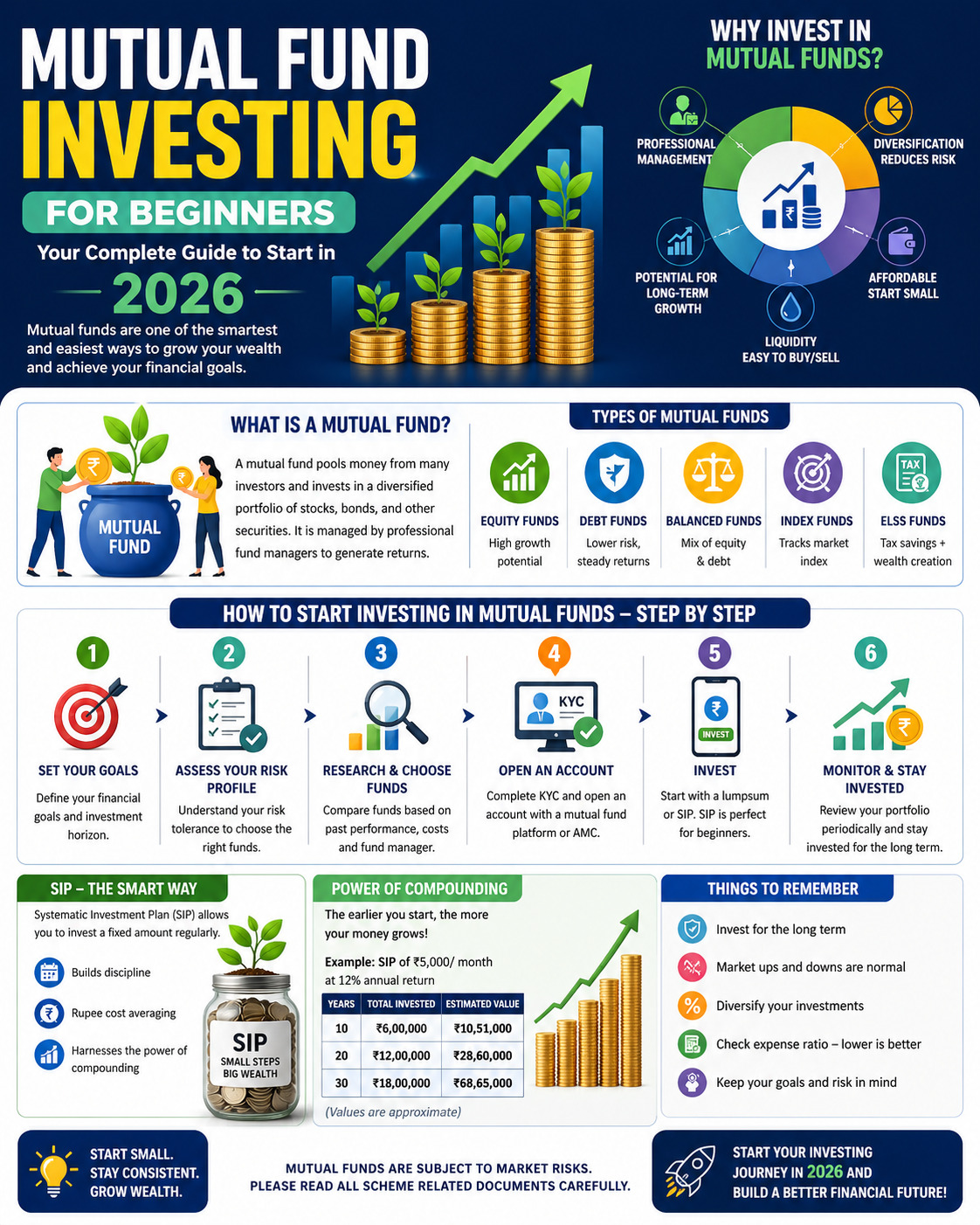
Mutual Fund Investing for Beginners: Complete Guide to Start in 2026
FinanceWise InvestingMutual FundsTax PlanningCalculators
Complete Beginner’s Guide · Updated 2026
📅 Last Updated: April 2026⏱ 25 min read✅ Reviewed by SEBI-registered advisors
Over ₹65 lakh crore is now managed by Indian mutual funds and 73% of first-time investors say they wish they’d started sooner. This guide is everything you actually need to start, skip the jargon, and build real wealth through mutual funds in 2026.
Table of Contents
- What Is a Mutual Fund? (Plain English)
- How Mutual Funds Actually Work
- Types of Mutual Funds Explained
- Step-by-Step: How to Start Investing
- SIP vs Lump Sum: Which Is Better for Beginners?
- How to Choose the Right Fund
- 7 Mistakes Beginners Always Make
- Tax Rules Every Investor Must Know
- Deep-Dive Guides (Child Pages)
- Frequently Asked Questions
What is a mutual fund? A mutual fund is a professionally managed investment vehicle that pools money from thousands of investors to purchase a diversified portfolio of stocks, bonds, or other securities. It works by appointing a fund manager who makes buy/sell decisions on behalf of all investors, each of whom owns units proportional to their investment. As of April 2026, AMFI India reports that mutual funds manage over ₹65 lakh crore in assets across 44 registered fund houses making them one of India’s most accessible and regulated investment tools.
₹65L CrTotal AUM managed by Indian mutual funds (2026)
9.4 CrActive SIP accounts as of March 2026
₹500Minimum amount to start a monthly SIP
How Mutual Funds Actually Work – No MBA Required
Let me give you the honest version nobody tells beginners: a mutual fund is basically a professionally run group investment club, except the club has thousands of members, a licensed manager with a fiduciary duty, and SEBI watching over everyone’s shoulder.
Here’s the simplest way to picture it. Imagine 10,000 people each put ₹10,000 into a pot. That’s ₹10 crore. A fund manager then deploys that money across 40–80 different companies. When those companies grow, the pot grows. You own a fraction called a unit of that pot, and its daily value is called the NAV (Net Asset Value).
NAV changes every business day. If you bought units at NAV ₹25 and it rises to ₹35 over three years, you’ve made a 40% return. That’s the whole mechanism.
📊 How NAV Is Calculated: NAV = (Total Market Value of Fund’s Assets − Liabilities) ÷ Total Units Outstanding. It’s published every business day after market close by each fund house, regulated by SEBI.
Who Manages Your Money?
Every mutual fund is managed by an Asset Management Company (AMC) – like HDFC AMC, Mirae Asset, or Axis Mutual Fund. The AMC employs fund managers (think: portfolio analysts with CFA degrees and 10-year track records) who decide exactly which stocks or bonds to buy and when to sell.
But here’s the kicker: you don’t actually need to trust any individual fund manager’s judgment. You can invest in index funds, which simply mirror an index like the Nifty 50, with zero active management involved. More on that in the types section.
“Most retail investors would be better served by low-cost index funds than by trying to pick winning active funds. Time in the market consistently beats timing the market, especially for beginners working with SIPs.”
Dr. Maneesh Dangi, Former Co-CIO, Aditya Birla Sun Life AMC & author of Macro-Investing in India
According to S&P SPIVA India Scorecard (2025), over a 10-year horizon, 74% of large-cap active funds underperformed their benchmark index. That’s not a reason to avoid mutual funds; it’s a reason to be selective about which type you choose.
Types of Mutual Funds: A Map Through the Jungle
Walk into the mutual fund universe blind, and you’ll find 2,500+ schemes. Walk in with this map, and suddenly it makes sense.
By Asset Class
| Fund Type | What It Invests In | Risk Level | Ideal For | Expected Return (10Y avg) |
|---|---|---|---|---|
| Equity Funds | Stocks (65%+ equity) | High | Long-term wealth creation (7+ years) | 12–15% p.a. |
| Debt Funds | Bonds, G-Secs, NCDs | Low–Medium | Capital preservation, short-term goals | 6–8% p.a. |
| Hybrid Funds | Mix of equity + debt | Medium | Moderate risk, 3–5 year horizon | 9–11% p.a. |
| Index Funds | Mirror an index (Nifty/Sensex) | Medium | Passive investors, beginners | 11–13% p.a. |
| ELSS Funds | Equity with 3-year lock-in | High | Tax saving under Section 80C | 12–14% p.a. |
| Liquid Funds | Money market instruments | Very Low | Emergency fund parking | 5–6% p.a. |
Note: Past returns are not guaranteed. All figures are approximate historical averages. Consult a SEBI-registered advisor before investing.
💡 Beginner’s Shortcut If you’re new to investing and don’t know where to start, the Nifty 50 Index Fund is widely recommended by financial advisors as a low-cost, low-complexity starting point. You get exposure to India’s 50 largest companies for as little as ₹500/month.
Step-by-Step: How to Start Investing in Mutual Funds in 2026
The entire process, from zero to first investment, takes about 30 minutes if you have your documents ready. Here’s exactly what to do:
01
Complete Your KYC (One-Time, 10 Minutes)
KYC (Know Your Customer) is mandatory for all mutual fund investments in India. You’ll need your PAN card, Aadhaar, and a selfie. Use the KFintech or CAMS KRA portal for paperless eKYC. Once done, it works across all AMCs you never do it again.
02
Choose Your Investment Platform
You can invest directly via the AMC website (zero commission, called “Direct Plans”), or through aggregator platforms like Zerodha Coin, Groww, or Paytm Money. Direct Plans have lower expense ratios typically 0.5–1% less per year, which compounds massively over a decade. (I’ll link our comparison guide below.)
03
Select Your Fund(s)
For beginners, the short answer: start with a large-cap index fund or a Nifty 50 index fund. Once you’re comfortable (3–6 months in), you can diversify into a mid-cap or flexi-cap fund. Don’t over-diversify immediately 2–3 well-chosen funds beat 12 randomly picked ones every time.
04
Start a SIP (Not Lump Sum, at First)
Set up a Systematic Investment Plan (SIP), a fixed monthly amount auto-debited from your bank account. It builds discipline, averages out market volatility (called rupee cost averaging), and removes emotion from investing. Even ₹1,000/month in a Nifty 50 index fund can grow to ₹23 lakh over 15 years at historical returns.
05
Set It, Review Annually – Don’t Touch It Daily
This is where most beginners fail. They check their portfolio every morning, panic when NAV drops 3%, and redeem at the worst time. The rule: review your portfolio once every 6–12 months. Check if funds are still performing relative to their benchmark. Otherwise? Let it grow.
SIP vs Lump Sum: The Honest Answer
You’ve probably seen the debate. Financial YouTube is full of videos claiming that one is always better. Here’s the truth: it depends on timing and your psychology.
| Factor | SIP (Systematic Investment Plan) | Lump Sum |
|---|---|---|
| Market Timing Risk | Eliminated (averages across prices) | High (you could buy at the peak) |
| Returns in Bull Market | Moderate | Higher (invested earlier) |
| Psychological Comfort | High | Stressful for beginners |
| Ideal For | Salaried investors, beginners, volatile markets | Windfall income (bonus, inheritance) in flat/bear markets |
| Minimum Amount | ₹500/month | ₹1,000 (most funds) |
“The best investment strategy is the one you can actually stick to for 10+ years without panicking.”
Research from ICICI Prudential AMC’s 2024 investor study found that SIP investors who stayed invested through all market downturns since 2015 outperformed those who paused SIPs during corrections by an average of 2.8% annually. Two-point-eight percent sounds small. Over 15 years, it’s the difference between ₹20 lakh and ₹28 lakh on a ₹5,000/month SIP.
How to Choose the Right Mutual Fund (Without Getting Paralyzed)
There are 2,500+ mutual fund schemes in India. That’s not a feature it’s a bug, at least for beginners. Here’s a simple filter framework:
The 5-Point Fund Filter
- Consistent 5-Year Returns: Check if the fund has beaten its benchmark index in at least 4 of the last 5 years, not just the last 1 year. A great 1-year performance often means a manager took concentrated bets that happened to work.
- Low Expense Ratio: For index funds, look for an expense ratio under 0.20%. For active equity funds, under 1.0% for Direct Plans. Every extra 0.5% in fees eats into your compounding.
- Fund Size (AUM): Avoid very small funds (under ₹500 crore AUM) and extremely large mid/small cap funds (over ₹20,000 crore too big to be nimble). For large-cap and index funds, bigger is fine.
- Fund Manager Track Record: Check how long the current manager has been running this specific fund. A 5-year return figure means nothing if the manager who earned it left 2 years ago.
- Direct Plan, Not Regular Plan: Direct Plans cut out the distributor and give you the same fund at a lower expense ratio. Use MF Central to invest directly in any fund house.
⚠️ Red Flags to Avoid: Steer clear of funds that: (1) have underperformed their benchmark for 3+ consecutive years, (2) frequently churn their portfolio (high turnover ratio above 150%), (3) are promoted aggressively by insurance agents or bank relationship managers, who may earn higher commissions from certain Regular Plans.
7 Mistakes Every Beginner Makes (I’ve Seen All of Them)
Look, I’ll be straight with you. Most beginners don’t fail because they picked the “wrong” fund. They fail because of behavior. Here are the seven mistakes I see over and over:
Mistake 1: Stopping SIPs During Market Crashes
This is the most expensive mistake. A market drop of 20% feels terrifying. But your SIP at ₹2,000/month just bought more units for the same money. That’s rupee cost averaging working for you, not against you. The investors who kept SIPs running through the COVID crash of March 2020 saw their portfolios double by December 2021.
Mistake 2: Owning Too Many Funds (“Diworsification”)
Owning 15 mutual funds doesn’t reduce risk; it just creates 15 sets of fees and a tracking nightmare. Three well-chosen funds (a large-cap index, a mid-cap fund, and a debt fund) cover 90% of what you need. Start there.
Mistake 3: Chasing Last Year’s Top Performer
Every January, someone asks: “Which fund gave 45% last year?” That’s the wrong question. Value Research Online data consistently shows that last year’s top-quartile funds often become next year’s bottom-quartile performers. Consistency beats peak performance.
Mistake 4: Investing Without an Emergency Fund
Never invest money in equity mutual funds that you might need in the next 12 months. Markets can drop 30–40% in a bad year. Keep 3–6 months of expenses in a liquid fund or savings account first, then invest the rest for the long term.
Mistake 5: Ignoring the Exit Load
Most equity funds charge an exit load of 1% if you redeem within 12 months. That doesn’t sound like much until you’re pulling ₹5 lakh out and handing ₹5,000 straight back to the fund house. Always check exit load before investing, especially for short-term goals.
Mistake 6: Treating NFOs Like IPOs
A New Fund Offer (NFO) is not like a stock IPO. There’s no “listing pop.” An NFO at ₹10/unit isn’t “cheaper” than an existing fund at ₹100/unit; the NAV means nothing in isolation. An existing fund with a 10-year track record almost always beats an NFO on risk-adjusted confidence.
Mistake 7: Not Nominating a Beneficiary
This sounds boring, but it isn’t. If something happens to you, your family will struggle to claim your mutual fund investments without a valid nominee. Set nominations when you open your account. Update them when life changes. This takes 5 minutes and can save months of legal trouble for your family.
Mutual Fund Taxes in 2026: The Numbers You Need
Tax rules changed significantly in the 2024 Union Budget. As of April 2026, here’s how mutual fund gains are taxed in India:
| Fund Type | Holding Period | Tax Rate | Exemption Limit |
|---|---|---|---|
| Equity Funds (65%+ equity) | Less than 12 months | 20% (STCG) | None |
| Equity Funds | 12 months or more | 12.5% (LTCG) | ₹1.25 lakh/year exempt |
| Debt Funds | Any holding period | Taxed at slab rate | None (post-Apr 2023 rule) |
| ELSS Funds | 3-year lock-in | 12.5% LTCG after lock-in | ₹1.5 lakh/yr deduction under 80C |
| Hybrid Funds (>65% equity) | 12+ months | 12.5% LTCG | ₹1.25 lakh/year exempt |
One smart strategy worth knowing: tax-loss harvesting. If you’re sitting on a losing fund, you can sell it (book the loss), switch to a similar fund, and use that capital loss to offset gains elsewhere in your portfolio. Many investors don’t do this and they’re leaving money on the table at tax time.
📌 ELSS Tax-Saving Shortcut ELSS (Equity Linked Savings Scheme) funds qualify for a ₹1.5 lakh deduction under Section 80C which saves up to ₹46,800 in tax for those in the 30% bracket. It has the shortest lock-in of all 80C instruments (just 3 years) and historically delivers equity-level returns. For most salaried investors, it’s the smartest way to make their tax-saving work harder.
🗂️ Deep-Dive Guides (Child Pages)
This pillar covers the full landscape. These focused guides go deeper on each topic:
📈 Best Index Funds in India 2026 💰 ELSS Funds: Complete Tax Saving Guide 🔢 SIP Calculator & Investment Strategy ⚖️ Direct Plan vs Regular Plan: Full Comparison 🌏 Mutual Fund Investing for NRIs 🏦 Debt Funds Explained for Beginners
Frequently Asked Questions
How much money do I need to start investing in mutual funds?
You can start a SIP in most mutual funds with as little as ₹500 per month. Lump sum investments typically require a minimum of ₹1,000. There’s no maximum limit. Most financial advisors suggest starting with whatever amount you can stay consistent with, rather than waiting to accumulate a “big enough” sum.
Is mutual fund investment safe?
Mutual funds are regulated by SEBI, and your money is held with a separate custodian, not the AMC, so fund house bankruptcy doesn’t affect your investment. However, all mutual funds carry market risk. Equity funds can lose 20–30% in bad years. There is no capital guarantee. The key is staying invested long enough for returns to normalize.
What is the difference between a Direct Plan and a Regular Plan?
Same fund, different fee structure. A Regular Plan is sold through distributors who earn a commission (typically 0.5–1% annual trail fee). A Direct Plan skips the distributor and passes those savings to you. Over 20 years, this 0.5–1% difference can mean 10–15% more wealth accumulated. Always invest in Direct Plans through the fund house website or MF Central.
Can I withdraw my mutual fund investment anytime?
Yes, for open-ended funds (most funds). Redemption requests are processed within T+2 to T+3 business days. Exceptions: ELSS funds have a 3-year lock-in per SIP installment, and closed-ended funds have fixed maturities. Always check the exit load before redeeming within the first year.
Which mutual fund is best for beginners in 2026?
Most financial advisors recommend starting with a Nifty 50 Index Fund (e.g., HDFC Nifty 50 Index Fund or UTI Nifty 50 Index Fund Direct Plans). These are low-cost (expense ratio under 0.10%), highly diversified, and track the 50 largest Indian companies. Once comfortable, you can add a mid-cap fund and an ELSS for tax savings.
What happens to my mutual fund if the AMC shuts down?
Your investment is protected by regulation. Under SEBI rules, mutual fund assets are held with a separate registered custodian; they cannot be used by the AMC for its own operations. If an AMC shuts down, SEBI steps in and either transfers the schemes to another AMC or triggers an orderly liquidation and refund to investors.
Sources & References
- AMFI India – Industry AUM Data, March 2026
- S&P SPIVA India Mid-Year Scorecard 2025
- SEBI Circulars – Mutual Fund Regulations
- Value Research Online – Fund Performance Data
- Income Tax India – STCG/LTCG Tax Rates FY2025-26
Disclaimer: This article is for educational purposes only and does not constitute investment advice. Mutual fund investments are subject to market risks. Please read all scheme-related documents carefully before investing. Past performance is not indicative of future results. We are not SEBI-registered investment advisors. Please consult a qualified financial advisor before making investment decisions.


Leave a comment