


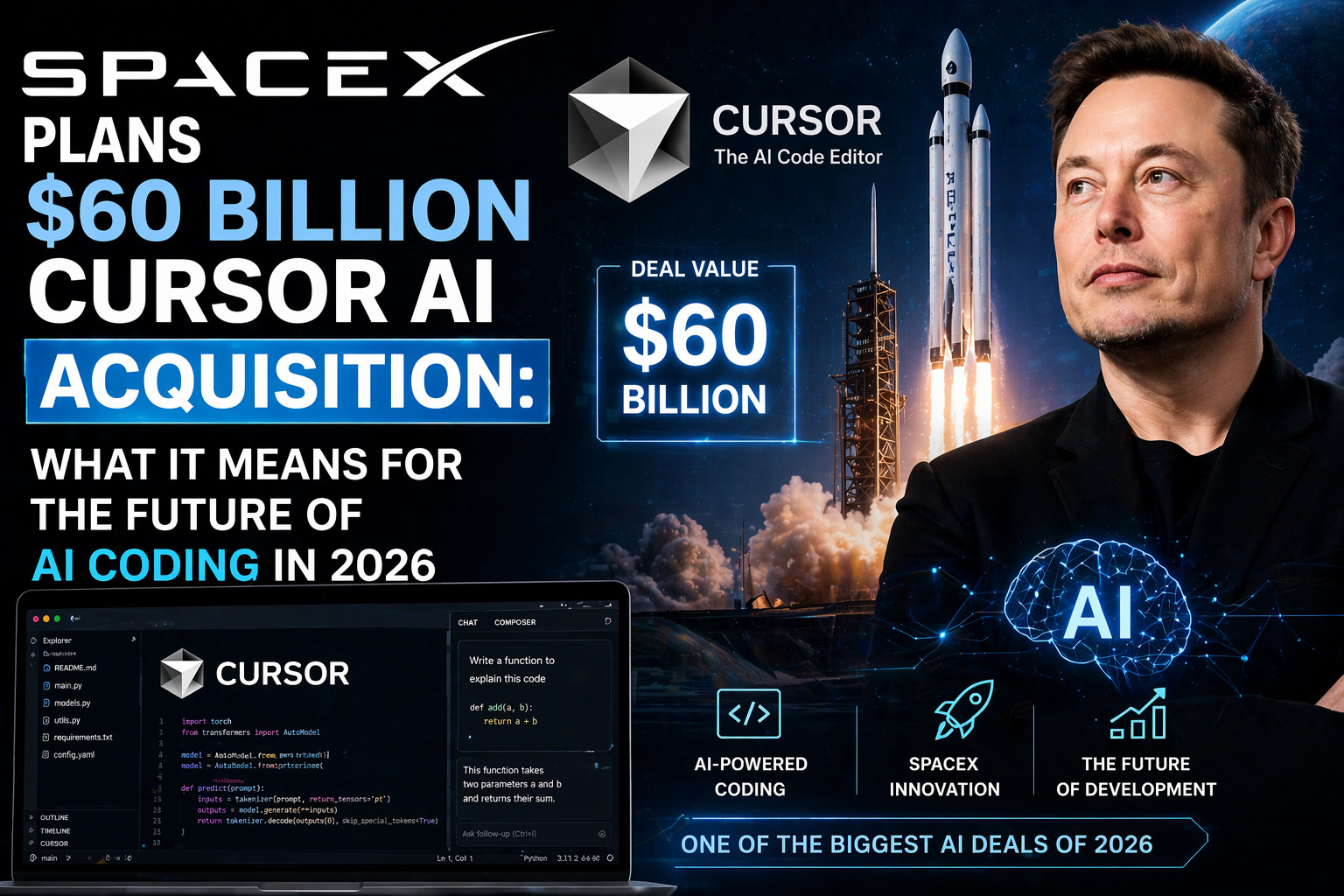
SpaceX Plans $60 Billion Cursor AI Acquisition: What It Means for the Future of AI Coding in 2026
Breaking · April 2026
Elon Musk’s rocket company just dropped the biggest deal in AI developer tools history. Here’s what actually happened, why it matters, and what every developer needs to know right now.
📅 April 22, 2026⏱ 15 min read✍️ Senior Tech Analyst🔄 Updated: April 22, 2026
$60BPotential Acquisition Price
$2B+Cursor ARR (Feb 2026)
$6B+Projected ARR by End 2026
67%Fortune 500 Customers
Table of Contents
- What Actually Happened: The Deal Structure Explained
- Cursor’s Meteoric Rise: From MIT Dorm Project to $60B Prize
- Why SpaceX Needs Cursor (And Why the Timing Is Everything)
- The AI Coding Wars: Cursor vs. Claude Code vs. Copilot vs. Codex
- What This Means for Developers Right Now
- Risks, Wildcards, and What Could Go Wrong
- FAQ
Quick Answer: The SpaceX Cursor AI acquisition is a deal announced on April 21, 2026, in which SpaceX, which absorbed Elon Musk’s AI lab xAI in February 2026, obtained the right to either acquire AI coding startup Cursor for $60 billion or pay $10 billion for joint product development. Cursor, built by four MIT graduates, is the fastest-growing SaaS company in history and had surpassed $2 billion in annualized revenue by February 2026. The deal represents the largest potential acquisition in the history of AI developer tools.
Let’s be direct: $60 billion for a four-year-old startup that started as a VS Code fork is either the deal of the century or the most expensive tech gamble since Microsoft paid $69 billion for Activision. Probably both.
On April 21, 2026, SpaceX dropped a bombshell on X: it had struck a deal with Cursor to jointly build “the world’s best coding and knowledge work AI,” with a stunning provision an option to acquire the startup outright for $60 billion later in 2026, or pay $10 billion for their collaborative work together. Cursor CEO Michael Truell responded by saying he was “excited to partner with the SpaceX team to scale up Composer,” referring to Cursor’s proprietary AI coding model.
But here’s the kicker: this isn’t just a business story. It’s a story about the future of how every software engineer on the planet will write code.
🔗 Deep-Dive Pages
Cursor vs. Claude Code: The Full Comparison Which AI coding tool wins in 2026? Speed, context, pricing, agent mode — head-to-head. Cursor’s Valuation Journey: $400M to $60B A timeline of every funding round and the metrics driving each leap. xAI + SpaceX: Inside Elon’s AI Empire How SpaceX, xAI, X, and Tesla are converging into one AI-industrial complex. The Future of AI Coding Tools in 2026 Beyond the IDE: autonomous agents, multi-model workflows, and what’s coming next.
What Actually Happened: The Deal Structure Explained
The announcement was characteristically Musk-ian, a single X post that sent the tech press into a frenzy. But the deal structure itself is genuinely unusual, even by Silicon Valley standards.
SpaceX hasn’t actually acquired Cursor yet. What it has secured is an option to acquire the company for $60 billion at some point later in 2026, or alternatively, pay $10 billion for the collaborative work the two companies are doing together. Think of it like an option contract on a house: you’re not buying it today, but nobody else can either.
The collaboration itself centers on Cursor’s AI editor capabilities meeting SpaceX’s Colossus supercomputer, an xAI asset that represents one of the largest clusters of AI compute on the planet. Cursor had already been renting compute from xAI’s data centers, using tens of thousands of xAI chips to train its latest model.
Why the dual-path structure? It gives SpaceX significant strategic flexibility. As analysis from Gotrade points out, the option structure “allows Musk’s team to evaluate the partnership’s results before committing to full ownership, while effectively preventing competing technology giants from acquiring Cursor in the meantime.” Smart. Whether or not the full acquisition happens, SpaceX has locked out OpenAI, Google, and Microsoft from swooping in.
This timing is deliberate. SpaceX is preparing for what many expect to be the largest IPO in history, potentially this summer. Having a cursor in (or near) its portfolio makes the story considerably more attractive to investors who want a piece of the AI coding market.
“SpaceXAI and @cursor_ai are now working closely together to create the world’s best coding and knowledge work AI.”- SpaceX, official post on X, April 21, 2026
The $10B vs. $60B Decision
Here’s something the headlines are glossing over: SpaceX might never actually buy Cursor. The $10 billion “pay for our work together” path is a real alternative one that leaves Cursor independent, potentially free to pursue its own IPO or further fundraising. Either way, Cursor’s CEO, Michael Truell, and the four co-founders (all MIT graduates – Michael Truell, Sualeh Asif, Arvid Lunnemark, and Aman Sanger) stand to become obscenely wealthy regardless of how it resolves.
A few days before this announcement, the New York Times reported that SpaceX had agreed to purchase Cursor for a flat $50 billion. SpaceX’s own X post corrected the record, revealing the more nuanced option structure. Minor detail, massive implications for Cursor’s independence.
Cursor’s Meteoric Rise: From MIT Dorm Project to $60B Prize
To understand why anyone would pay $60 billion for Cursor, you need to understand just how unprecedented its growth has been. I don’t use that word lightly. Unprecedented.
Four MIT students launched Cursor in 2022 as an AI-powered fork of VS Code. At the start of 2025, the company was valued at $2.5 billion. Twelve months later: $30 billion. By April 2026: $50 billion in their latest funding round before this SpaceX deal even entered the picture.
August 2024
Series A – $60M raised at $400M valuation
First institutional funding; product gaining traction among indie developers.
December 2024
Series B – $105M raised at $2.5B valuation
Cursor reaches $100M ARR run rate.
June 2025
Series C – $900M raised at $9.9B valuation
$500M ARR milestone; over 50% of Fortune 500 using Cursor.
November 2025
Series D — $2.3B raised at $29.3B valuation
$1B ARR crossed; Composer (proprietary model) launched.
February 2026
$2B+ ARR milestone
Revenue doubles in 3 months; enterprise accounts 60%+ of revenue.
April 2026
New $2B round at $50B valuation + SpaceX $60B deal
The most consequential week in Cursor’s history.
To put this in perspective: Martin Casado, General Partner at Andreessen Horowitz and a Cursor board member, summed it up bluntly: “If you subtract out the dollars invested, it’s the fastest-growing company we’ve ever seen.” And a16z has seen a few companies.
According to Sacra’s research, Cursor is now the fastest-growing SaaS company of all time, from $1M to $500M in ARR, a title that surpasses previous records held by Slack, Zoom, and Snowflake. Revenue was doubling approximately every two months through most of 2025.
What Cursor Actually Does (For Non-Developers)
Cursor is an AI-powered code editor built on top of Microsoft’s VS Code. But calling it a “code editor” in 2026 is like calling Spotify a “music file player.” The product has evolved into something closer to an autonomous coding co-pilot.
Developers use it to write, review, debug, and refactor code, often just by describing what they want in plain English. The editor then writes the code, suggests multi-file changes, runs tests, and in its latest agentic form, can handle entire features with minimal human input. Cursor’s Composer 2 model (launched March 2026) supports these multi-step workflows with near-zero latency.
As of early 2026, Cursor generates an estimated 150 million lines of enterprise code every single day. Over 50,000 engineering teams and 67% of Fortune 1000 companies, including NVIDIA, Uber, Adobe, Salesforce, and PwC, use it.
Why SpaceX Needs Cursor (And Why the Timing Is Everything)
Let’s be honest: SpaceX doesn’t build rockets using Cursor. So what’s actually going on here?
This isn’t about SpaceX, the rocket company. It’s about SpaceX-as-AI-holding-company, a structure Elon Musk has been building since he merged SpaceX with xAI in February 2026, a deal he valued at $1.25 trillion. xAI, Musk’s AI venture, also controls the social network X (formerly Twitter). Think of it as an AI-industrial conglomerate wearing a rocket ship’s name badge.
The problem? xAI is widely acknowledged to be trailing its peers. In March 2026, forecaster Peter Wildeford published an analysis showing that among major AI developers, Anthropic, Google, and OpenAI form the first tier, while xAI lags behind by approximately seven months in model capability. Musk publicly acknowledged the gap and stated they’d close it by the end of 2026.
Buying Cursor (or locking it down) is his fastest path to relevance in the AI developer market.
The Three Strategic Reasons This Deal Makes Sense
1. Instant distribution among professional developers. Building a competing product from scratch would take years. Cursor already has the developer relationships, the brand trust, and the usage habits of over a million daily active developers. You can’t replicate that with a press release.
2. A flywheel for model training. Cursor’s users generate billions of lines of code daily. That’s an extraordinary proprietary training dataset for specialized coding AI models. Combined with Colossus – xAI’s supercomputer, the potential for a purpose-built developer AI that neither OpenAI nor Anthropic can match is genuinely plausible.
3. IPO optics. SpaceX’s planned summer IPO needs a compelling AI story. “We might own the fastest-growing enterprise software company in history” is a hell of an investor pitch. Whether or not the $60 billion acquisition actually closes, the option itself makes the IPO prospectus significantly more interesting.
“This potential acquisition represents xAI’s most aggressive move yet to directly compete with OpenAI and Anthropic in the lucrative developer-facing AI tools market.”- Gotrade analysis, April 2026
The Awkward Problem Cursor Currently Has
Here’s the thing most coverage is missing: Cursor currently depends on Anthropic and OpenAI for the very models it resells. It pays retail pricing to access models that its competitors – Claude Code (Anthropic) and Codex (OpenAI) – get at wholesale or internal cost.
As TechCrunch noted, “Cursor still uses and sells access to Claude and GPT models even as both firms roll out their own coding tools, an awkward arrangement that this new SpaceX partnership may be designed to eventually escape.” The partnership with xAI, and potentially a full acquisition, gives Cursor a path out of that dependency.
The risk, of course, is that abandoning Claude and GPT models, which many developers specifically love, could trigger a user exodus. Cursor’s value isn’t just the editor. It’s the model choice inside the editor.
The AI Coding Wars: Cursor vs. Claude Code vs. Copilot vs. Codex
The AI coding tools market in 2026 is, to put it diplomatically, extremely crowded. Let’s map the battlefield clearly, because this context is essential for understanding why the SpaceX deal is happening now.
| Tool | Parent | Strengths | Weaknesses | 2026 Status |
|---|---|---|---|---|
| Cursor | Anysphere (→ SpaceX?) | Speed, IDE integration, multi-agent mode | Dependent on rival models; IDE-centric | Dominant |
| Claude Code | Anthropic | 1M token context, enterprise power, agentic depth | Terminal-based; less beginner-friendly | Surging |
| GitHub Copilot | Microsoft/GitHub | Native IDE integration, huge install base | Less agentic; slower to innovate | Holding |
| OpenAI Codex | OpenAI | o3 reasoning models, catching up fast | Late mover to the tools market | Catching Up |
| Gemini Code | Google DeepMind | Deep Google Workspace integration | Enterprise-focused, less indie traction | Enterprise |
| xAI / Grok | SpaceX/xAI | Colossus compute, Cursor partnership (soon) | Lagging ~7 months vs. top-tier models | Catching Up |
The market itself is enormous. Research and Markets estimates the AI coding tools sector at $9.5 billion in 2026, growing at a 22% CAGR through 2030. With AI-generated or AI-assisted code now exceeding 50% of all new GitHub commits, this market is no longer optional infrastructure it’s the default.
The Claude Code Threat Cursor Can’t Ignore
There’s a subplot in the Cursor story that deserves more airtime: Claude Code nearly ate Cursor’s lunch.
When Anthropic launched Claude Code in May 2025 as a command-line AI coding agent, developers adopted it with striking speed. By late 2025, surveys indicated Claude Code had overtaken both Cursor and GitHub Copilot as the most-used AI coding tool among professional software engineers. Meanwhile, Claude Code reached a $2.5 billion run rate and over 300,000 business customers by early 2026.
This is existentially significant for Cursor because Anthropic’s Claude is also one of the models Cursor depends on. Anthropic gets the model revenue, the user data, and increasingly the direct developer relationship. A JetBrains survey from January 2026 found that 29% of developers used GitHub Copilot at work, 18% used Cursor, and 18% used Claude Code. Cursor’s lead is narrowing.
The SpaceX deal can be read, in part, as Cursor’s strategic response: if you can’t beat the model makers by using their models, get your own.
What This Means for Developers Right Now
You’re probably reading this because you use Cursor, are evaluating Cursor, or work in a company that does. So let’s cut to what actually matters.
Short-term: Nothing Changes (Yet)
If you’re a Cursor user, your workflow isn’t changing tomorrow. The deal is an option, not a closed acquisition. Cursor’s models — including its Composer 2, Claude integration, and GPT access remain in place. Michael Truell’s post on X emphasized continuity: this is a partnership, not a handoff.
But watch this space. The next 6 months will reveal whether SpaceX exercises the acquisition option, and what that means for Cursor’s model licensing agreements with Anthropic and OpenAI.
Medium-term: Model Access Could Shift
Here’s where developers need to pay attention. If SpaceX acquires Cursor fully, there’s a real question about whether Anthropic and OpenAI would maintain their model licensing to a fully Musk-owned competitor. Musk v. Altman a high-profile legal case between the SpaceX founder and OpenAI CEO Sam Altman, begins trial just days after this announcement. That context matters.
A Cursor under SpaceX control would almost certainly pivot toward xAI’s Grok models for core functionality. Whether Grok can match Claude or GPT-4o for code quality in 2026 is the central unanswered question. As of now, most developers say no – but xAI’s trajectory is upward.
The Pricing Question
Cursor’s current pricing is:
- Free – limited AI features
- Pro: $20/month – core developer tier
- Business: $40/user/month – team features
- Ultra: $200/month – 20x usage vs. Pro
- Enterprise: Custom pricing
An acquisition by a well-capitalized SpaceX could go one of two ways: aggressive price cuts to compete with Claude Code (which Anthropic has been able to price aggressively due to model cost advantages), or price increases as the enterprise business matures. Based on the trajectory of Musk’s other acquisitions, I’d bet on short-term price competition followed by longer-term monetization of the enterprise segment.
The Agentic Coding Shift
Ultimately, the biggest implication for developers isn’t about which company owns Cursor. It’s about where the IDE-as-product is heading. Warp CEO Zach Lloyd put it plainly: “‘The IDE is dead’ is real. That’s just not how software is being built now.”
The shift to autonomous, multi-agent workflows where AI doesn’t assist developers but acts as developers is accelerating. Cursor 2.0 already supports up to eight parallel agents. The SpaceX-Colossus combination could push this further, faster. For developers, the question isn’t “which editor do I use?” It’s “how much of my job is still mine to do in 2027?”
Risks, Wildcards, and What Could Go Wrong
Let’s be intellectually honest here. There are real risks on all sides.
Risk 1: Model Partners Bail
Cursor’s current product quality depends significantly on Claude and GPT-4 class models. If a SpaceX acquisition prompts Anthropic or OpenAI to revoke or restrict licensing, Cursor could face a product quality cliff while xAI’s Grok models catch up. That gap, even if temporary, could permanently shift developer loyalty to Claude Code or Copilot.
Risk 2: SpaceX Walks Away from the $60B
The option structure means SpaceX is under no obligation to close. If Cursor’s growth slows, if the Musk v. Altman litigation creates regulatory complications, or if SpaceX’s IPO runs into turbulence, the company could elect to pay $10 billion for the collaboration and let Cursor go independent. For Cursor, that’s still a $10 billion check but not the full exit its investors are counting on at $60B.
Risk 3: The “IDE Is Dead” Problem
Several prominent developers and analysts argue that Cursor’s IDE-centric model is already becoming obsolete. If agentic coding means developers increasingly interact with AI through terminal interfaces (like Claude Code) or autonomous pipelines rather than an editor, Cursor’s core product could face a structural challenge regardless of who owns it.
Risk 4: xAI Still Trails
Peter Wildeford’s analysis showing xAI roughly seven months behind Anthropic and Google isn’t just an ego problem; it’s a product problem. If Grok-based models aren’t competitive enough for professional coding tasks, developers will walk regardless of the Cursor brand. Revenue growth at $6 billion, projected ARR by the end of 2026, assumes continued model quality parity or improvement.
The research is actually mixed here; some developer surveys show Cursor comfortably ahead, others show Claude Code pulling away. Your mileage will genuinely vary depending on your specific use case, tech stack, and whether you’re an individual developer or an enterprise engineering team.
Frequently Asked Questions
Has SpaceX actually acquired Cursor?
No, not yet. SpaceX announced on April 21, 2026, that it has secured the option to acquire Cursor for $60 billion at some point later in 2026. Alternatively, it may pay $10 billion for the collaborative work the two companies are doing together. The deal hasn’t closed, and may not close at the full $60 billion figure.
How is Cursor valued at $60 billion when it was worth $2.5 billion just 15 months ago?
Cursor’s ARR went from roughly $100 million in January 2025 to $2 billion in February 2026 a 20x revenue increase in 13 months. The company forecasts $6 billion+ ARR by the end of 2026. At those growth rates, premium valuation multiples are defensible by SaaS standards. The $60 billion figure implies roughly a 10x forward revenue multiple on projected 2026 ARR, aggressive, but not unprecedented for the fastest-growing SaaS company ever measured.
What is xAI’s role in the SpaceX-Cursor deal?
xAI Elon Musk’s AI research lab merged with SpaceX in February 2026. The combined entity controls both the SpaceX rocket business and xAI’s AI models (Grok), the Colossus supercomputer, and the social network X. The Cursor deal is being driven by xAI’s ambitions to compete with Anthropic and OpenAI in the developer AI market. xAI had already been renting computing power to Cursor before the acquisition option was announced.
Should I switch from Cursor to Claude Code or another tool now?
There’s no urgent reason to switch right now. Cursor’s models, features, and pricing are unchanged. If and when an acquisition closes, watch for changes to the model lineup, particularly whether Anthropic’s Claude remains available within Cursor. For developers who specifically value Claude’s 1M token context window or its enterprise-grade security, Claude Code is increasingly compelling as a standalone alternative.
Who are Cursor’s founders?
Cursor was founded in 2022 by four MIT students: Michael Truell (CEO), Sualeh Asif, Arvid Lunnemark, and Aman Sanger. The company operates under parent entity Anysphere, Inc. Notable angel investors include Stripe co-founder Patrick Collison, former GitHub CEO Nat Friedman, and Dropbox co-founder Arash Ferdowsi.
What is Cursor Composer?
Composer is Cursor’s proprietary AI model for coding, first launched in October 2025. It’s described as 4x faster than comparable frontier models and optimized for multi-step, multi-file coding tasks. Composer 2, released March 2026, adds faster default operation and API-accessible token pricing. The model trains on over 1 billion lines of code generated by Cursor users daily, creating a proprietary data flywheel.
The Bottom Line
The SpaceX Cursor AI acquisition or option, to be precise, is one of the most consequential deals in the short history of AI developer tools. It doesn’t matter if the $60 billion actually closes: the strategic signal is already clear.
Elon Musk believes AI coding tools will be worth trillions in value over the next decade, and he’s willing to pay a historically unprecedented price to be at the center of it. Cursor’s founders built something in four years that the entire VC industry and three of the world’s most powerful tech companies are now fighting over.
For developers, the honest answer is: keep watching, keep your options open, and don’t delete your Claude Code subscription just yet. The AI coding market is moving faster than any individual company — or billionaire can fully control.
The war for your terminal isn’t over. It’s just getting interesting.
📚 Continue Reading
Cursor vs. Claude Code (2026) The definitive comparison – speed, context window, pricing, agentic capabilities. SpaceX IPO & AI Strategy: How Cursor fits into the SpaceX IPO narrative and Musk’s trillion-dollar AI bet. Cursor’s Valuation History $400M → $60B in 18 months. Every round, every milestone, is explained. Best AI Coding Tools 2026 Full market comparison: Cursor, Claude Code, Copilot, Codex, Windsurf.






Leave a comment